
Home > Boats for sale Germany > Buying a Boat in Germany: VAT, Registration and Berths
Buying a boat in Germany is a purchase inside the Union customs area, so the first question is whether VAT has been paid and whether the seller can prove it. German customs set the rule for a boat arriving from outside the EU: import VAT of 19 percent and import duty of about 1.7 percent of value, with no duty on a sea-going boat of 12 m hull length or more. For a boat already in the EU the proof is a paper trail, such as a dealer’s invoice showing VAT, a manufacturer’s certificate or customs clearance documents. After tax come the register, the flag certificate, the berth and the survey. This guide follows the purchase in the order it happens and says what we do at each stage.
In this guide: what the price really includes; how the purchase works, stage by stage; the figures in one table; reading the condition of a used boat; why appoint EYB; questions buyers ask.
The asking price is only the start. VAT comes first, and the position depends on where the boat has been. A boat used by EU residents inside the EU must be in free circulation, which means VAT has been paid or the boat has been cleared through customs, according to SeaHelp’s guide to import charges. For a boat that comes from outside the EU, the Generalzolldirektion leaflet for boat skippers, dated May 2026, gives import VAT of 19 percent. It gives import duty of about 1.7 percent of value, and none for a sea-going boat of 12 m hull length or more. ADAC Skipper, the motoring club’s boating guide, gives the same pairing of 1.7 percent duty and 19 percent import VAT.
Ask the seller how VAT status can be shown. ADAC Skipper lists three documents that usually serve as proof: a dealer’s sales invoice that shows the VAT, a certificate of VAT payment from the manufacturer or supplier, and customs clearance documents. The European Commission’s Guidance Note for Pleasure Craft, dated 30 April 2026, covers proof of Union status, temporary admission and returned goods.
Check also who is selling. Dealers may sell used goods under the margin scheme in section 25a of the German VAT Act, in which the invoice does not show VAT separately, according to the Hamburg Chamber of Commerce. The invoice alone may therefore not settle the question, so ask for the document trail from the boat’s first sale.
If the boat is exported from the EU after purchase, the sale is exempt from EU VAT when the exporter keeps records and the customs proof of export, according to EU Access2Markets.
The other large items are the register and the berth. A measurement certificate is the first one. Simplified measurement by the BSH, the federal maritime agency, is available for boats up to 24 m and costs EUR 180 to 450 including the certificate, according to the MARCOM boat-buying guide. A flag certificate costs EUR 107, according to the BSH. Berths vary by marina; the Marina Heiligenhafen price page shows one 2026 tariff, and the table below gives 2026 tariffs for four named places. A survey by a qualified expert is charged at about EUR 1,000 per day plus travel, according to the VBS surveyors’ association.
What we do: the head office coordinates with a local broker, and we handle enquiries and negotiations in your language, so the questions on VAT proof, registration and berth go to the seller and the marina in writing and the answers reach you before you make an offer.
Stage one: offer, deposit and contract. Once the offer and the sale terms are agreed, the buyer pays a 10 percent deposit into escrow, and the balance goes to the seller when the contract conditions are met. Those conditions should name the VAT documents, the registry papers and the survey result, so you are not committed before you know the boat. In a private sale, ADAC Skipper says an exclusion of the seller’s warranty is allowed and customary, including when a broker is involved. A dealer may limit liability for used boats to one year, and a defect that appears in that first year is presumed to have existed at handover. Boat24, the marketplace, advises that a request for an advance payment is mostly fraud. What we do: a lawyer prepares the sale contract, and we ask that it carry the document list and the survey condition.
Stage two: VAT status and customs. For a boat in the EU, ask for the proof listed above before the balance is paid. For a boat bought outside the EU and brought to Germany, German customs say it must be presented to a customs office and declared on arrival. The coastal offices are, on the Baltic, Flensburg, Rendsburg, Kiel (Schwentinental), Heiligenhafen, Lübeck, Wismar, Rostock, Stralsund-Dänholm, Mukran and Wolgast. On the North Sea they are Bremen, Bremerhaven, Hamburg, Brunsbüttel, Husum, Papenburg, Emden, Cuxhaven, Wilhelmshaven, Brake and Stade. Clearance outside opening hours is as a rule subject to a fee. A boat owned by a person established outside the EU and used privately may stay for 18 months under temporary admission, and German customs say an extension is in principle not granted. A boat that left the EU and returns within three years unchanged is duty-free as returned goods. What we do: the head office puts the customs question to the authority through the local broker, and the route is chosen before you pay.
Stage three: register and flag. Germany has about 500,000 pleasure boats, according to the Deutsche Flagge site. Entry in a sea-ship register is compulsory for a German-flag pleasure boat above 15 m hull length and voluntary below it. There is no single national register: the registers are kept by the district courts, and the court responsible follows the home port or the owner’s home. A BSH measurement certificate is a condition of entry. At the Hamburg court, a first entry needs an application, proof of ownership such as the purchase contract, a copy of the owner’s identity document, the measurement certificate and proof that the boat is in no other register. A boat can be deleted from a register only when no encumbrances remain, so ask the seller for the current register extract, and agree that any charge is cleared before the balance is paid.
For a sea-going boat up to 15 m, the BSH page on flag certificates explains the flag certificate, which proves the right to fly the German flag and is not proof of ownership. It costs EUR 107, is valid for 8 years according to ELWIS, the federal waterways information service, and has been issued as an electronic document since December 2025. Those entitled to it are Germans and EU nationals resident in Germany, and the boat must not be in any register. It must be returned when the boat is sold. What we do: we settle the flag and the register with you before the deposit, in your language.
Stage four: licence and insurance. A boating licence is required on the sea waterways and on the inland waterways for engines above 11.03 kW (15 PS), according to ELWIS. No statutory liability insurance applies to private boats in Germany, according to transparent-beraten.de, though a berth, club or charter contract can require it. Ask each marina or club what cover it demands, and ask an insurer for a quote on the specific boat.
Stage five: berth, survey and handover. Survey, haul-out and sea trial can be arranged at your expense, in that order, before the balance is paid. At handover, collect the register papers or the flag certificate, the VAT documents, the service history and the manuals. What we do: a survey, haul-out and sea trial can be arranged at your expense, and the head office coordinates them with the local broker.
| Item | Figure | Applies to, and whose figure |
|---|---|---|
| Import VAT | 19 percent | Boat imported into Germany; Generalzolldirektion leaflet, May 2026 |
| Import duty | about 1.7 percent of value; none for a sea-going boat of 12 m hull length or more | Boat imported into Germany; Generalzolldirektion leaflet, May 2026 |
| Temporary admission | 18 months | Privately used boat of a person established outside the EU; Generalzolldirektion, May 2026 |
| Sea-ship register | compulsory above 15 m hull length | German-flag pleasure boat; Deutsche Flagge |
| Simplified measurement | EUR 180 to 450 | Boat up to 24 m; MARCOM, modified 17 November 2025 |
| Flag certificate | EUR 107; valid 8 years | Sea-going boat up to 15 m; BSH fee, ELWIS validity (Stand 31 October 2022) |
| International Boat Certificate | about EUR 35; renewal about EUR 30 every 2 years | Proof of ownership; MARCOM, modified 17 November 2025 |
| Licence threshold | engines above 11.03 kW (15 PS) | Sea and inland waterways; ELWIS, Stand 3 December 2025 |
| Season berth, 3.25 x 12 m | EUR 1,638.74 | Marina Heiligenhafen, 2026 tariff, including VAT |
| Guest berth, 9 to 10.99 m / 11 to 12.99 m | EUR 21 / EUR 25 per day | Marina Heiligenhafen, 2026 tariff; electricity EUR 3 per day |
| Berth, 8 x 3 m | EUR 1,840.32 | ancora Marina, Neustadt in Holstein, list valid from 1 January 2026, gross |
| Water berth, summer season | EUR 49.50 per m² | Sporthafen Kiel, summer season 2026 |
| Winter storage, open-air / hall | EUR 15 / EUR 42 per m² | Sporthafen Kiel, summer season 2026 |
| Storage, open-air / hall | EUR 20 / EUR 36 per m² | Yachtwerft Heiligenhafen, Stand September 2025, including VAT |
| Kiel Canal passage | EUR 12 to 43, ends 1 January 2027 | Pleasure boats, by length; Federal Ministry of Transport, 2026 |
| Survey by an expert | about EUR 1,000 per day plus travel | VBS surveyors' association |
Figures as of 28 October 2026 unless dated, from the sources listed below.
Use the table against the boat you are looking at. Berth figures differ by marina, so ask the one you intend to use for its tariff for your boat length.
A used boat in Germany is judged on its own papers and survey. Ask the seller for the boat’s history, its previous use and its service record. Boat24 lists boats from private sellers and from dealers, so ask which kind of seller you are dealing with, because the warranty position described above differs between them.
Bareboat charter under the German flag needs a charter certificate for the boat, issued for 2 years, according to Deutsche Flagge, so ex-charter boats exist on the market and the seller should say if the boat was one. The surveyor Schneider Yacht Experts compared 50 ex-charter reports with 50 owner-boat reports. Ex-charter boats were weaker in hull and interior appearance, slightly worse structurally and better technically, which is the pattern to look for in your own survey.
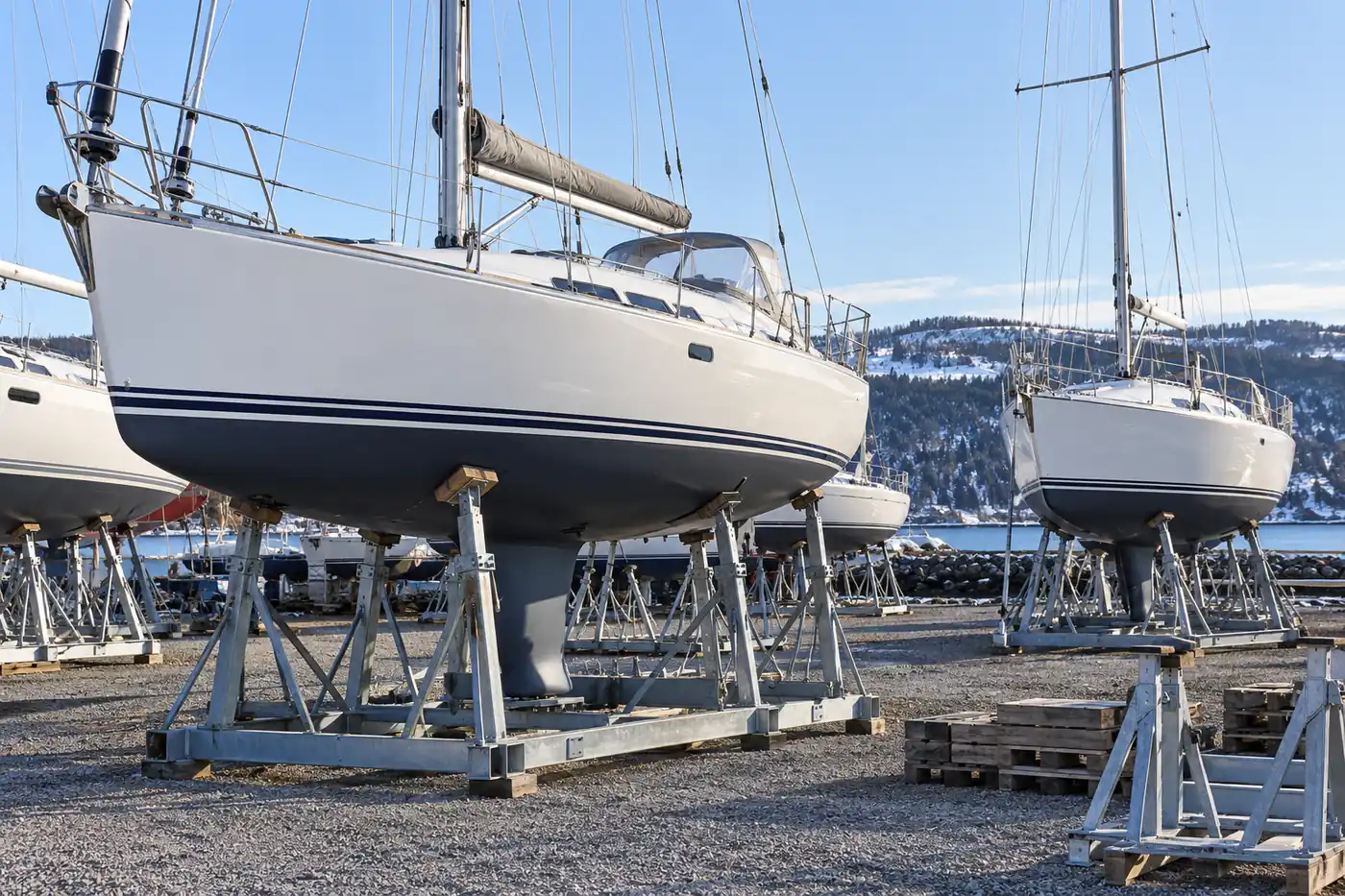
Appoint your own surveyor, independent of the seller and of any broker, and agree in the contract what happens to the findings: a price reduction, repair before delivery, or the right to withdraw. Ask for a lift-out, so that hull, keel, rudder and running gear are inspected out of the water, and compare engine hours with the service records. Check the hull and engine numbers against the papers, as Boat24 advises.
Ask about haul-out by name. Sporthafen Kiel prices winter storage at EUR 15 per m² in the open and EUR 42 per m² in a hall. Yachtwerft Heiligenhafen prices open-air storage at EUR 20 per m² and hall storage at EUR 36 per m², including VAT. Ask each for the lift capacity, the date and the price in writing. A seller who cannot produce the register papers, the VAT documents and a lift-out date should not receive a deposit.
What we do: a survey, haul-out and sea trial can be arranged at your expense, and the head office coordinates them with the local broker.
We act for the buyer. The head office coordinates the purchase with a local broker, a lawyer prepares the sale contract, and you pay a 10 percent deposit into escrow after the offer and sale terms are agreed, then the balance to the seller when the contract conditions are met. A survey, haul-out and sea trial can be arranged at your expense. We handle enquiries, viewings and negotiations in your language, so you deal with one office instead of a chain of them.
We know where a purchase stalls, and in Germany that is the VAT proof, the register extract and the berth. You can see current listings among our boats for sale in Germany. Germany has 60 marinas on our list, on 2 coasts: the Baltic Sea coast with 49 and the North Sea coast with 11. Our pages for yacht brokers on the Baltic Sea coast and yacht brokers on the North Sea coast cover each coast, and our page on yacht brokers in Germany sets out how we work there. Among the largest are ancora Marina with 1,400 berths and Marina Heiligenhafen with 1,000 berths. We do not rush buyers: a good boat survives a careful look.
Tell us the boat, or the kind of boat, you are considering, and we will explain how we would approach it and what our involvement as your broker would include. Write to info@europeanyachtbrokers.com.
Check four things before you agree a price. First, the VAT position: ask the seller for the dealer invoice showing VAT, the manufacturer’s certificate or the customs clearance documents, and for a boat from outside the EU, the import papers. Second, the ownership and the register: for a boat on a sea-ship register, ask for the current extract and confirm that no encumbrance is entered, since a boat can be deleted only when none remains. Third, an independent survey with a lift-out. Fourth, the berth, since marina tariffs differ widely by coast. We coordinate these checks with the local broker.
The documents usually accepted are a dealer’s sales invoice showing the VAT, a certificate of VAT payment from the manufacturer or supplier, or customs clearance documents, according to ADAC Skipper. A dealer selling under the margin scheme does not show VAT on the invoice, according to the Hamburg Chamber of Commerce, so ask what the paper trail from the first sale looks like. For a boat from outside the EU, German customs state import VAT of 19 percent and import duty of about 1.7 percent, with no duty on a sea-going boat of 12 m or more. Ask the seller to confirm the status in writing before you pay. We put the question to the seller through the local broker and negotiate in your language.
There is no single national register: the district courts keep the sea-ship registers, and the court responsible follows the home port or the owner’s home, according to Deutsche Flagge. Registration is compulsory above 15 m hull length and voluntary below it. For a sea-going boat up to 15 m the flag certificate is open to Germans and EU nationals resident in Germany, so a buyer from outside the EU should ask the BSH in writing what applies to the intended flag before deciding. A first entry needs proof of ownership, an identity document, a measurement certificate and proof that the boat is in no other register. We coordinate the purchase, including these questions, with the local broker.
No statutory liability insurance applies to private pleasure boats in Germany, according to transparent-beraten.de, which reports the position in 2026. A duty can still arise by contract: ports, clubs and charter operators may require cover, and a lessor must insure a rental boat that is used without a licence. So the practical answer depends on the berth and the use. Ask the marina or club in writing what cover it requires, and ask an insurer for a quote on the specific boat and for the cover it would give. We put these questions through the local broker and handle the correspondence in your language.
Price each item in writing before you commit. At Marina Heiligenhafen a season berth of 3.25 x 12 m costs EUR 1,638.74 in the 2026 tariff, including VAT. At ancora Marina an 8 x 3 m berth costs EUR 1,840.32 gross on the list valid from 1 January 2026, and at Sporthafen Kiel a summer water berth costs EUR 49.50 per m². Storage ashore is extra: Yachtwerft Heiligenhafen charges EUR 20 per m² in the open and EUR 36 per m² in a hall. The Kiel Canal passage charge for pleasure boats, EUR 12 to 43, ends on 1 January 2027. We handle those enquiries for you, in your language.
Yes, an independent survey belongs in every purchase of a used boat, and when buying a boat in Germany the seller’s warranty is often excluded, which makes it more important. ADAC Skipper says exclusion is allowed and customary in private sales and when a broker is involved, while a dealer may limit liability to one year. A survey by a qualified expert is charged at about EUR 1,000 per day plus travel, according to the VBS surveyors’ association. Appoint a surveyor independent of the seller and of any broker, ask for a lift-out and agree what happens to the findings. We can arrange it at your expense.
Facts retrieved and read on 28 October 2026. Author: European Yacht Brokers.