CLAUDIA´S
MANGUSTA 92 Claudia’s is a fine example of the famous Mangusta 92 series and is the penultimate yacht built of this series. Claudia’s is a 28.27m Mediterranean sport
THE EYB COUNTRY GUIDES · France
Use the June 2026 Division 240 text to check the actual yacht, crew, shelter distances and equipment readiness.
By Peter Mattey · 9 min read · Facts checked 2026-10-03
Boat safety equipment France must be matched to the actual yacht, crew and intended route. The required inventory changes with distance from a suitable shelter, and equipment has to be serviceable and accessible when needed. Buyers should review it before a trial or delivery; sellers should identify what is included and supply the relevant service evidence. This guide explains selected current official requirements and practical checks, using the revised text rather than treating an old inventory as proof of readiness.
The examples concern conventional recreational yachts within the stated Division 240 scope. They are not a substitute for the full current equipment list or the specific rules for tenders, personal watercraft and other craft. Confirm the applicable requirements with the maritime authority and skipper before navigation, using the actual route and conditions. For anything this guide does not cover, email us at info@europeanyachtbrokers.com for the latest information.
Key facts at a glance
Division 240, edition marked JORF 8 June 2026, covers sea-going use and safety equipment for personal or training recreational craft of hull length up to 24 metres.
French Maritime Ministry, Division 240 current text ·Division 240's current Article 240-1.02 defines shelter by safe anchoring, landing or berthing and departure without assistance, accounting for current weather, sea conditions and vessel characteristics.
French Maritime Ministry, Division 240 current text ·Current Article 240-2.01 requires children weighing no more than 30 kg to have flotation performance level 100 regardless of distance from shelter.
French Maritime Ministry, Division 240 current text ·Current Article 240-2.01 requires the lanyard attached while the engine is on for its specified equipped outboard boats/personal watercraft, an accessible second lanyard in navigation and the stated precautions when the driver leaves the controls.
French Maritime Ministry, Division 240 current text ·Current Division 240 Article 240-2.05 covers 6 to less than 60 nautical miles from shelter and requires flotation level 150 for each person, fixed VHF and suitable inflatable survival-raft capacity for everyone aboard.
French Maritime Ministry, Division 240 current text ·Section 1
Division 240 covers sea-going conditions of use and safety equipment for personal or training recreational craft of hull length up to 24 metres. The Ministry's construction guidance says the equipment framework applies whether the craft is CE marked or not. As practical advice, identify the actual vessel category and intended navigation before preparing an inventory. A tender, personal watercraft or other specialised craft can have its own provisions, so this guide's selected conventional-yacht examples should not be used as a complete equipment list for every floating craft.
The current official text includes the amendment of 21 May 2026 and carries the edition marking JORF 8 June 2026. The Ministry explains that the update clarifies lending and rental declarations and corrects numbering inconsistencies from previous changes. As practical advice, use the current text when comparing articles or a seller's earlier checklist. A dated leaflet can explain the broad idea but should not be relied upon to settle a current exception or article reference without checking the relevant provision in the applicable edition.
Distance is measured from a shelter, whose official definition takes account of current weather, sea conditions and the characteristics of the boat. It means a coastal place where the boat and crew can make themselves safe by anchoring, landing or berthing and depart without assistance. As practical advice, plan the route around real suitable shelters rather than a straight-line distance to any point on the shore. Ask the skipper to review the inventory for the intended journey and conditions, including a purchase trial or delivery passage.
Broker tip: Practical recommendation: use the current text and the actual boat category to prepare the inventory. Ask the skipper to identify suitable shelters for the intended route and conditions rather than measuring only the distance to shore. A related question is answered in our guide on whether you need a boat licence in France.
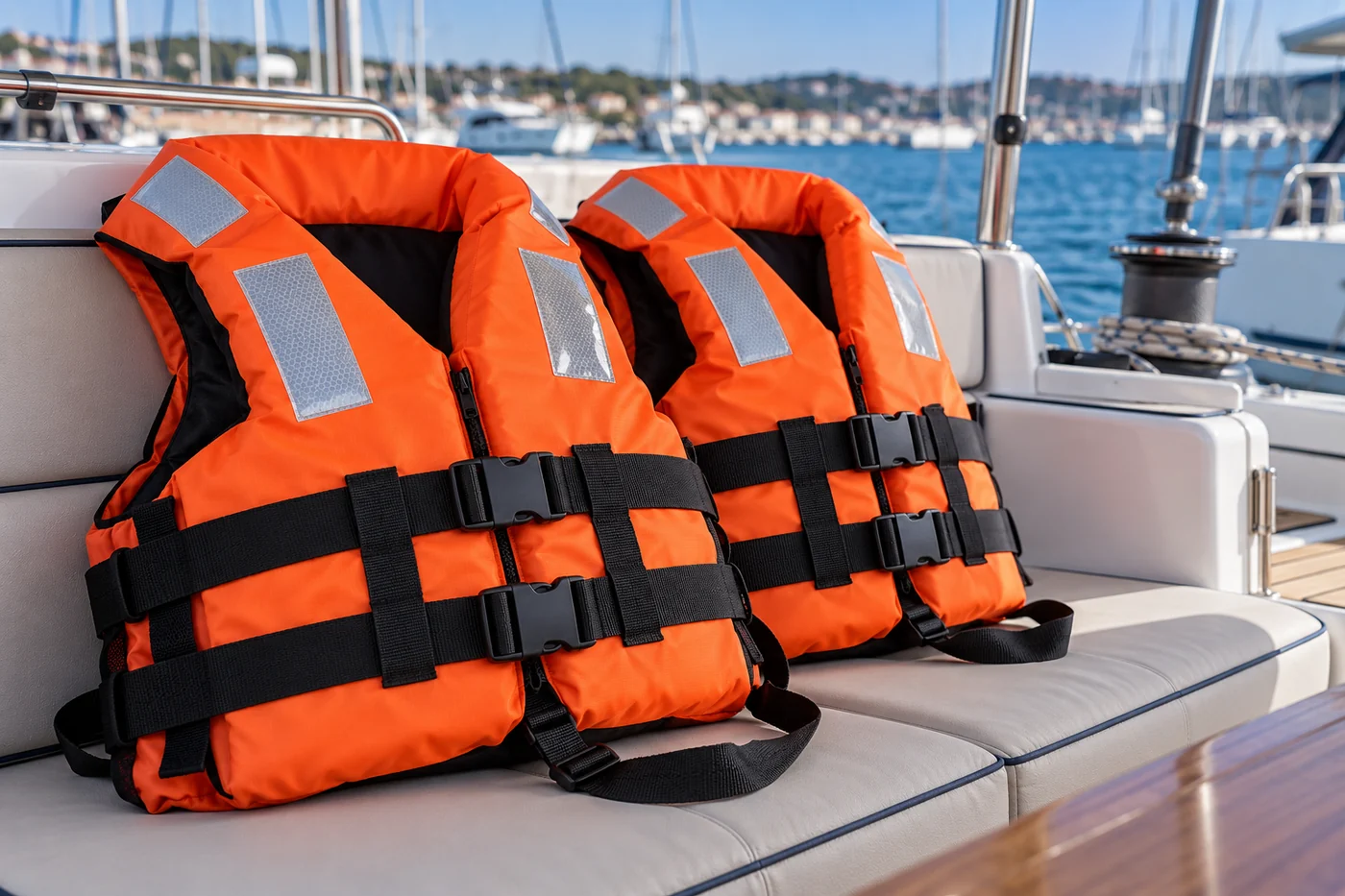
Boat safety equipment: lifejackets stowed on a yacht.
Division scope
Section 2
Article 240-2.03 addresses conventional pleasure vessels navigating less than 2 nautical miles from a shelter. Its basic list includes individual flotation arrangements, lighting, portable extinguishers, suitable manual bailing where required, towing equipment and appropriate anchoring subject to the stated exceptions. As practical advice, inspect the actual equipment and access to it before a trial or handover, then use the full article for the yacht's details. The presence of an old inventory or a storage locker does not show that the required items are ready to serve.
The general provisions require equipment adapted to the craft, maintained in working condition, current with applicable technical inspections and ready for an emergency. They prohibit storing safety equipment in machinery spaces and specify alternatives where other storage is unavailable. As practical advice, ask the owner to demonstrate access and supply service records for equipment needing inspection. Note anything missing or unserviceable in the handover record so that the skipper can arrange replacement or servicing before a passage rather than assuming an inspection will happen after departure.
For children weighing no more than 30 kg, the current text requires flotation performance level 100 regardless of distance from a shelter. The basic lighting provision requires a waterproof light with at least 6 hours of autonomy, with specified collective or personal arrangements. As practical advice, check each user's suitable flotation and the light's actual condition before leaving the berth. This guide does not simplify the adult flotation alternatives into a universal wear rule; the relevant provision and the skipper's safety decisions need their own review.
Broker tip: Practical recommendation: inspect flotation sizes, lighting, access and service records before a trial. Record missing or unserviceable equipment and have the skipper resolve it against the full current article before committing the yacht to a passage. See also our guide on what boat insurance you need in France.

Boat safety equipment: hand flares and distress signals.
Basic navigation provision
Looking at a boat in France and want a second opinion before you commit? Speak to one of our brokers.
Section 3
For navigation from 2 to less than 6 nautical miles from shelter, Article 240-2.04 adds coastal equipment and specifies the flotation requirements and alternatives. Among its additions are a suitable person-overboard locating and assistance device and 3 red hand flares. As practical advice, ask the skipper to review the full list, the actual flotation arrangements and the flare serviceability before a coastal passage. These selected facts are useful checks but do not replace the complete article or establish that every yacht in a marina is already equipped for this route.
The coastal article requires a suitable magnetic steering compass, with the specified visibility, compensation, lighting and independence from power apart from lighting. It also calls for current official charts or extracts for the navigation area, collision-regulation information and the relevant buoyage-system document. As practical advice, inspect the working navigation aids and confirm that electronic documents remain readable aboard. An installed display should not automatically be treated as satisfying the compass provision, and an outdated chart should be resolved before it is used to plan the proposed delivery.
For the specified equipped outboard boats and personal watercraft, the general provision requires the emergency-stop lanyard attached to the driver while the engine is on. It also requires an accessible second lanyard in navigation and deals with the driver moving away from the controls. As practical advice, have the skipper demonstrate the actual controls and brief the crew before a trial. Confirm the provision against the yacht's equipment and construction requirements rather than turning the selected outboard rule into an unsupported statement about every inboard engine installation. Selected conventional-yacht examples do not replace the full current Division 240 list, referenced technical standards or specific tender/personal-watercraft provisions. No universal equipment price or claim that an existing inventory establishes compliance is made. For these, email us at info@europeanyachtbrokers.com for the latest information.
Broker tip: Practical recommendation: review the complete coastal list with the skipper, then test access, controls and navigation aids. Check flares and documents for serviceability and currency before treating the boat as ready for the intended trial or delivery. Readers often go on to our guide on whether you need a boat survey in France.

Boat safety equipment: EPIRB distress beacon on a yacht.
Coastal additions
Current Division 240 Article 240-2.04 covers 2 to less than 6 nautical miles from shelter and includes a suitable person-overboard locating/assistance device and 3 red hand flares among additions, with specified flotation requirements and alternatives.
Source: French Maritime Ministry, Division 240 current textCurrent Article 240-2.04 requires a magnetic steering compass meeting its visibility, class, compensation and lighting provisions and independent of power except for lighting.
Source: French Maritime Ministry, Division 240 current textCurrent Article 240-2.04 requires current official charts/extracts covering the navigation area, collision-regulation information and the area's buoyage-system document, under its stated paper/electronic provisions.
Source: French Maritime Ministry, Division 240 current textCurrent Article 240-2.01 requires the lanyard attached while the engine is on for its specified equipped outboard boats/personal watercraft, an accessible second lanyard in navigation and the stated precautions when the driver leaves the controls.
Source: French Maritime Ministry, Division 240 current textSection 4
From 6 to less than 60 nautical miles from shelter, Article 240-2.05 adds semi-offshore requirements to the coastal equipment. It requires flotation performance level 150 for each person, a fixed VHF installation and inflatable survival raft capacity for everyone aboard under the specified standard. As practical advice, confirm the real crew and route, then inspect the equipment and current service evidence with the skipper. A seller's description of offshore capability should not decide whether the actual raft capacity, flotation and radio installation meet the planned departure's requirements.
The semi-offshore list also includes navigation plotting equipment, a current light list, an up-to-date logbook, marine weather reception and the specified first-aid kit and searchlight. It distinguishes harness arrangements for sailing and non-sailing vessels. As practical advice, have the skipper explain where the items are kept and how they will be used, and obtain specialist servicing where the equipment requires it. This guide does not turn the selected list into a complete technical specification for every item; the full article and referenced provisions remain essential to the inventory review.
At 60 nautical miles or more from shelter, Article 240-2.06 adds a distress-position radio beacon, waterproof handheld VHF and the specified survival-raft type or class requirements. It recommends an additional satellite communication device, rather than presenting it as a compulsory item in that paragraph. As practical advice, distinguish required and recommended equipment when costing the preparation, and brief everyone on its location and use. Ask the skipper to resolve the applicable radio and equipment requirements before sailing, alongside the separate review of qualification, weather and vessel condition.
Broker tip: Practical recommendation: have the skipper check the complete longer-passage inventory and service dates against the planned crew and route. Separate compulsory equipment from recommendations in the budget, and brief everyone on access and use before departure. Our guide on how much a berth costs in France covers a related point.
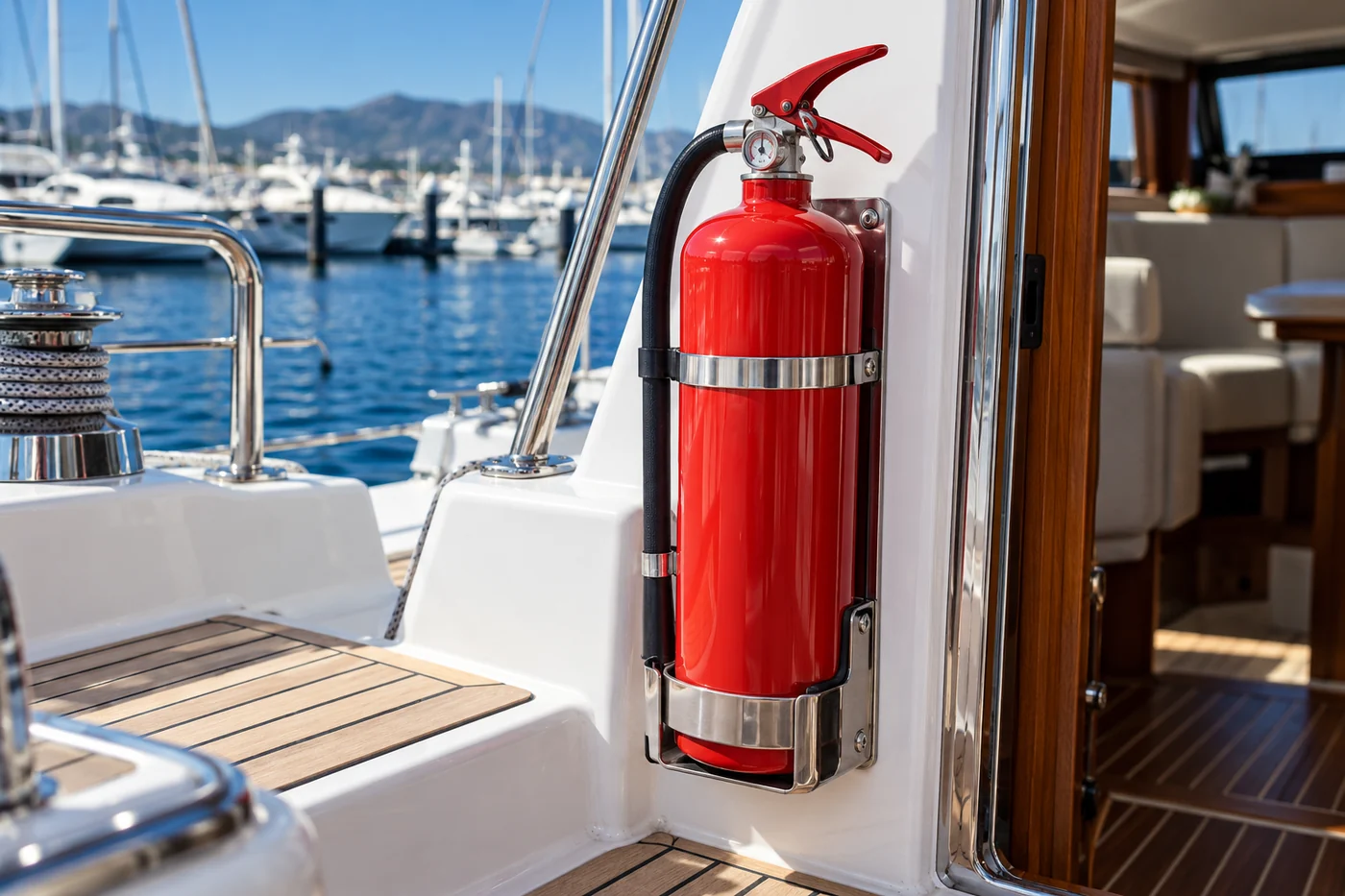
Boat safety equipment: fire extinguisher fitted on a yacht.
Semi offshore core additions
Practical support
Peter Mattey is a yacht broker at European Yacht Brokers with a BA in Law. He is not a French lawyer: for French law and tax we refer you to a locally qualified adviser. What we can do is help you plan the purchase, put the right questions to the other side and spot gaps in the paperwork before you commit.
If you are looking for a boat in France, tell us the type of boat, your budget and the area through the enquiry form on this page and a broker will reply. For anything this guide does not cover, email us at info@europeanyachtbrokers.com for the latest information.

Written by
Peter Mattey
Yacht Broker, European Yacht Brokers
BA (Law). Expert in marine law

The handover of a boat at the dock.
Your questions
No, the Maritime Ministry says Division 240 defines safety equipment for craft whether they are CE marked or not. As practical advice, establish the yacht's actual category, intended navigation and relevant current provisions before preparing an inventory. Keep construction conformity evidence separate from the review of equipment carried, serviceability and access, since the documents and the operational safety list address different questions. (French Maritime Ministry, recreational boat construction and conformity)
The official definition takes account of the weather, sea conditions and boat characteristics, with safe anchoring, landing or berthing and departure without assistance. As practical advice, have the skipper identify genuinely suitable shelters for the proposed route rather than measuring distance to any shoreline point. Use those conditions to review the relevant equipment category before a trial or delivery passage. (French Maritime Ministry, Division 240 current text)
No, the current text has a specific rule for children at its stated weight threshold regardless of distance from shelter. Adult arrangements and alternatives also need their relevant article reviewed. As practical advice, check each person's suitable flotation, condition and accessibility before departure, and have the skipper explain the equipment and safety decisions instead of assuming a generic locker inventory suits every guest. (French Maritime Ministry, Division 240 current text)
The cited offshore paragraph recommends an additional satellite communication device, while separately specifying compulsory offshore additions. As practical advice, distinguish the required inventory from recommendations when budgeting and planning the passage. Ask the skipper to review the full current provisions, the actual radio installations and the intended route before treating any selected equipment summary as a complete compliance checklist. (French Maritime Ministry, Division 240 current text)
No, it selects verified requirements and identifies the current official text rather than reproducing every technical provision or exception. As practical advice, review the complete applicable articles and referenced specifications with the skipper and competent authority, then inspect the actual equipment and service records. Resolve missing, unserviceable or unsuitable items before relying on the yacht for a trial, delivery or later voyage. (French Maritime Ministry, Division 240 current text)
This guide only includes facts checked against official sources. For anything it does not cover, email us at info@europeanyachtbrokers.com for the latest information, and ask a locally qualified adviser to confirm the position for your own boat.
Ready when you are
MANGUSTA 92 Claudia’s is a fine example of the famous Mangusta 92 series and is the penultimate yacht built of this series. Claudia’s is a 28.27m Mediterranean sport

PERSHING 7X Pershing 7X – Motivated Seller | Nearly New | Private Use Only | Warranty Remaining The owner is motivated to secure a sale,
FERRETTI 920 Alegria II is a 28.5m motor yacht built by Ferretti Yachts in Italy and delivered in 2020. Representing the renowned quality and craftsmanship
Check it yourself
Official Division 240, amendment of 21 May 2026, edition marked JORF 8 June 2026; downloaded and relevant articles read 3 October 2026.
Official construction and conformity guidance updated 2 March 2026; opened 3 October 2026, including CE documents, permanent identification, post-construction assessment and Division 245.
Official explanation updated 30 June 2026; opened 3 October 2026. Current regulatory text used for details and exceptions.
Keep reading
Talk to European Yacht Brokers
Looking for a boat in France? Tell us what you need
Tell us the type of boat, budget and area and a broker will reply.