

Buying a boat in Greece comes down to three questions that the price does not answer: whether EU VAT has been paid on the boat, whether the Greek cruising tax TEPAI is up to date, and who holds the sailing permit. The answers sit in papers, and each paper has a Greek authority behind it. TEPAI, for example, applies to every private boat over 7 m in Greek waters whatever its flag, and the holder or user of the boat is liable jointly with the owner for the tax and for any fine. This guide is for buyers from the EU and beyond who are looking at a used boat. It follows the purchase in the order it happens, says where a question has to go to the seller or an authority, and says what we do at each stage.
In this guide: what the price really includes; how the purchase works, stage by stage; the figures in one table; reading the condition of a used boat; why appoint EYB; questions buyers ask.

The asking price is only the start, and VAT comes first. The standard Greek rate is 24 percent, according to the PwC tax summaries, and a used boat is judged on its VAT-paid status. Boat Tomorrow’s 2026 guide names the original VAT invoice, the customs declaration for free circulation and an official VAT certificate as proof. The European Commission’s guidance note of 30 April 2026 also accepts a T2L or T2LF document, and says customs ask for proof only in rare cases of doubt. Noonsite reported in May 2025 that Greek Customs check the VAT status of yachts arriving from outside the EU rigorously, and that the proof should be an official Customs document with an MRN number or a T2L. Ask the seller for that document before you make an offer, and compare two offers only when each says whether VAT is paid.
Ask also whether the boat was ever a Greek charter or professional yacht. Aegean Sailing School says Greek professional yachts are bought VAT exempt and that an EU buyer of such a yacht must pay the VAT in addition to the purchase price. The VAT position of an ex-charter boat therefore sits in its papers, and the seller should show them.
The official fees are small. Topline’s checklist for the Port Authority lists two EUR 3 triplicates for a change of ownership, one in favour of MTN and one for EKOEMN. The Hellenic Coast Guard’s e-DLA service lists a sailing permit for a leisure boat up to 10 m at EUR 50 plus an EKOEMN contribution of EUR 20, valid for four years. Ask the Port Authority which fees apply to your boat before you pay.
The annual costs are the larger variable. TEPAI is charged per month by overall length, according to the AADE FAQ of 23 January 2026: EUR 16 for over 7 m up to 8 m, EUR 25 up to 10 m, EUR 33 up to 12 m, and EUR 8 per metre per month from the first metre for a boat over 12 m. The FAQ lists a 10 percent reduction for paying the whole year in advance and a 20 percent reduction for a ship over 12 m that stays in Greek ports all year. Liability insurance is compulsory under Law 4926/2022, with minimum cover of EUR 150,000 per person and EUR 700,000 per incident for death or bodily injury, according to Pantaenius.
The berth completes the picture. Alimos Marina’s July 2026 price list shows EUR 840 a month at sea for a permanent monohull or motor yacht up to 12.99 m, before VAT and with electricity and water charged separately. Its berthing cost page lists lifting and launching at EUR 100 up to 15 m. Get the tariff of your chosen marina in writing before you buy.
What we do: we handle enquiries and negotiations in your language, and the head office coordinates with a local broker, so the questions on VAT proof, fees, TEPAI and berth go to the seller and the authorities in writing and the answers reach you before you make an offer.

Stage one: offer, deposit and contract. Once the offer and the sale terms are agreed, the buyer pays a 10 percent deposit into escrow, and the balance goes to the seller when the contract conditions are met. Those conditions should name the VAT proof, the sailing permit, the register position and the survey result, so you are not committed before you know the boat. Topline’s checklist for the Port Authority requires a stamped private agreement stating that the boat is transferred free of every encumbrance, maritime lien and debt to port funds. What we do: a lawyer prepares the sale contract, and we ask that it carry the document list and the survey condition.
Stage two: VAT and customs status. For a boat already in the EU with VAT paid, the proof is the invoice, customs declaration or certificate described above. A boat that arrives from outside the EU needs a Transit Log. AADE says a private pleasure boat over 7 m with a third-country flag, or with an EU flag and an owner habitually resident in a third country, on which duties and taxes are unpaid, receives a Transit Log with a defined validity of 18 months, and the European Commission gives the same 18 months for temporary admission. The AADE page on temporary importation says the boat must be re-exported when the right of movement expires. A log has unlimited validity where the customs duties have been paid, according to AADE’s press release of 7 August 2024. The Transit Log is filed on the myAADE portal, and Noonsite reports fines of EUR 300 at some ports for skippers who did not apply online in advance. Ask customs in writing which rule covers your boat, flag and residence. What we do: the head office puts that question to customs through the local broker, and the route is chosen before you pay.
Stage three: liens, debts and ownership. Ask the seller to prove that the boat is free of mortgage, port debts and unpaid TEPAI. The Official Guide to Ship Registries says no vessel is deleted from the Greek registry while a mortgage is recorded unless the holder has given prior written consent or a discharge, and Topline’s checklist asks for a bank document where a mortgage is registered and a certificate of no debt for port dues. The AADE FAQ makes the shipowner, holder or user liable jointly and severally for TEPAI and any fine, and says a ship found in breach has its documents withheld and its departure prohibited until the amount due and the fine are paid. Ask the seller for the TEPAI payment record. What we do: a lawyer prepares the sale contract, and we ask that it carry the encumbrance statement and the document list.
Stage four: transfer and sailing permit. A Greek-language guide describes the transfer in five steps: the sale agreement, a check of debts and of the register, payment of the transfer fee, a visit to the Port Authority, and issue of the new documents. Topline’s checklist adds the buyer’s application in duplicate, three photographs of the buyer, the tax number (AFM), declarations on equipment, and the presence of buyer and seller or an authorised person. After a transfer of more than 50 percent, the Hellenic Coast Guard e-DLA page provides for a new sailing permit, valid for four years for a boat up to 10 m, filed online through Taxisnet. Ask the Port Authority in writing which documents it requires from a foreign buyer. What we do: the head office coordinates the file with the local broker so the originals are ready before the sale closes.
Stage five: insurance, TEPAI and handover. Insurance and TEPAI are arranged before you sail. Roditis Shipping Agency says proof of insurance must be shown on arrival and gives a EUR 150 penalty, and the Royal Yachting Association says a Greek translation of the insurance document must be carried on board. TEPAI is paid before each month of stay, or for the whole year in advance in December or January. When the owner or user changes, the AADE FAQ says to keep the documents proving the change and to enter the new details at the next payment. At handover, collect the original registration papers, the sailing permit, the VAT proof, the TEPAI records, the service history and the manuals. What we do: a sea trial can be arranged at your expense before the balance is paid to the seller.
| Item | Figure | Applies to, and whose figure |
|---|---|---|
| Standard VAT rate | 24 percent | Greece; PwC tax summaries, undated |
| Temporary admission and Transit Log with defined validity | 18 months | EU rule, European Commission guidance note of 30 April 2026; AADE, undated |
| TEPAI, over 7 m up to 8 m | EUR 16 per month | AADE FAQ, 23 January 2026 |
| TEPAI, over 8 m up to 10 m | EUR 25 per month | AADE FAQ, 23 January 2026 |
| TEPAI, over 10 m up to 12 m | EUR 33 per month | AADE FAQ, 23 January 2026 |
| TEPAI, over 12 m | EUR 8 per metre per month | AADE FAQ, 23 January 2026 |
| Liability insurance, death or bodily injury | EUR 150,000 per person; EUR 700,000 per incident | Law 4926/2022; Pantaenius, 13 December 2022 |
| Sailing permit, leisure boat up to 10 m | EUR 50 plus EUR 20 EKOEMN; valid 4 years | Hellenic Coast Guard e-DLA, undated |
| Change of ownership triplicates | EUR 3 plus EUR 3 | Topline checklist for the Port Authority, November 2024 |
| Alimos Marina, permanent monohull up to 12.99 m | EUR 840 per month, excluding VAT | Alimos Marina price list, July 2026 |
| Alimos Marina, lifting and launching up to 15 m | EUR 100 | Alimos Marina cost page, October 2026 |
| Fine for no advance online Transit Log, at some ports | EUR 300 | Noonsite, May 2025 |
| Travel lifts | Gouvia 65 T and 75 T; Lefkas 150 t and 70 t | D-Marin, 2026 |
Figures as of 28 October 2026 unless dated, from the sources listed below.
Use the table against the boat you are looking at. The VAT proof and the customs route come first, because each changes the price. TEPAI and insurance are charges that continue after the sale, so ask for the payment record and the policy before the balance is paid.
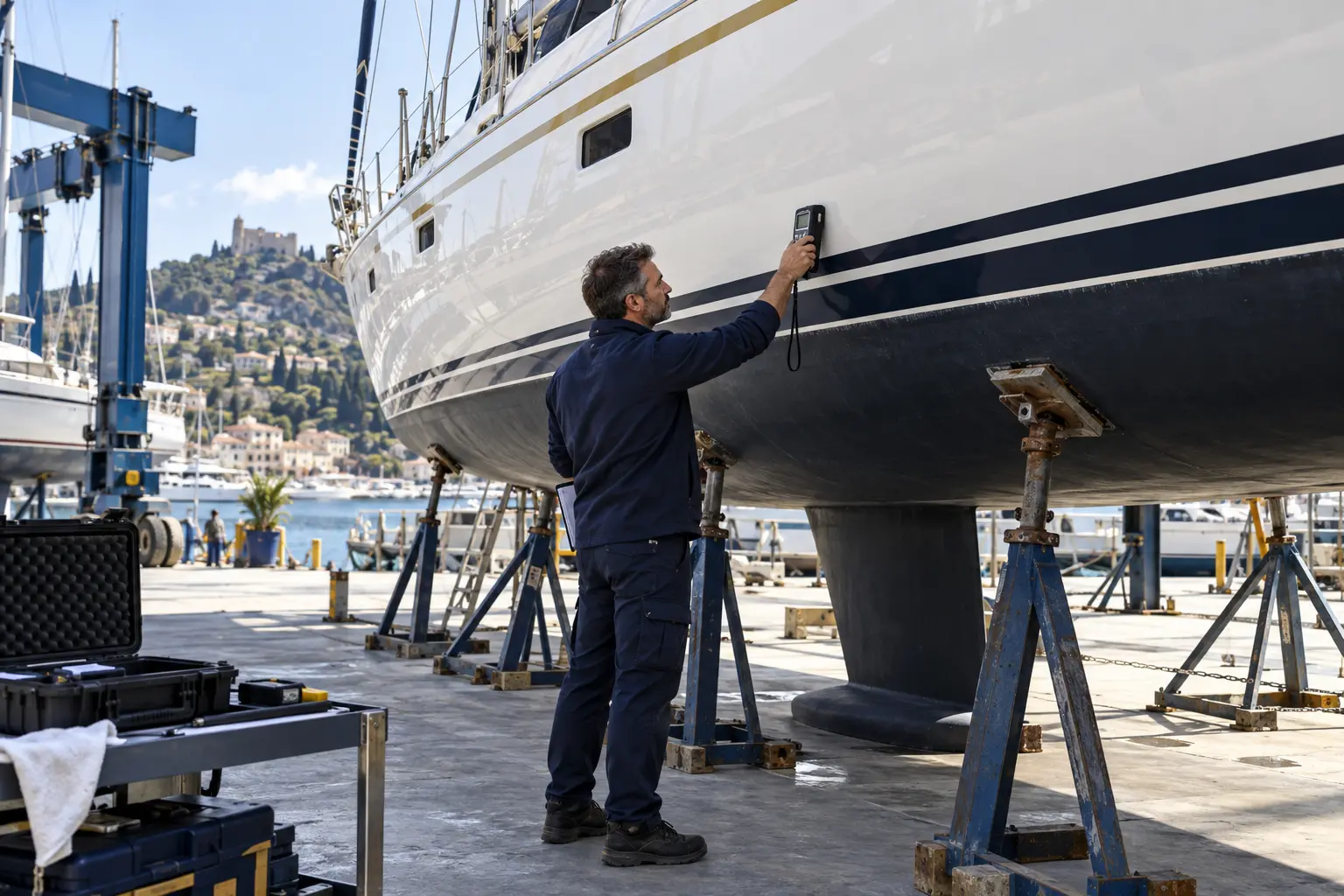
A used boat in Greece is judged on its papers and its survey. ClearHull says the Alimos Marina at Kalamaki houses hundreds of boats, many coming directly out of charter fleets, and that VAT and paperwork there need careful checking because listings may contain mistakes. Aegean Sailing School warns that a charter yacht may have suffered major hull damage, been patched up and offered for resale without mention of it. Ask the seller for the boat’s charter history, damage record and service record in writing.
Appoint your own surveyor, independent of the seller and of any broker, and agree in the contract what happens to the findings: a price reduction, repair before delivery, or the right to withdraw. Ask for a lift-out, so that hull, keel, rudder and running gear are inspected out of the water, and compare engine hours with the service records.
Ask about haul-out by name. D-Marin Gouvia on Corfu lists travel lifts of 65 T and 75 T and 500 dry-dock places, D-Marin Lefkas lists two travel lifts of 150 tons and 70 tons and a 60-ton mobile crane, and ClearHull describes Lefkas and Preveza as having a concentration of surveyors and marine services. Ask each yard for the lift capacity, the date and the price in writing. A seller who cannot produce the VAT proof, the sailing permit and a lift-out date should not receive a deposit.
What we do: a survey, haul-out and sea trial can be arranged at your expense, and the head office coordinates them with the local broker.

We act for the buyer. The head office coordinates the purchase with a local broker, a lawyer prepares the sale contract, and you pay a 10 percent deposit into escrow after the offer and sale terms are agreed, then the balance to the seller when the contract conditions are met. A survey, haul-out and sea trial can be arranged at your expense. We handle enquiries, viewings and negotiations in your language, so you deal with one office instead of a chain of them.
The points to settle early in Greece are the VAT proof, the Transit Log question for a boat from outside the EU, and the debt and TEPAI record. You can see current listings among our boats for sale in Greece, or by coast: the boats for sale in the Ionian Islands, the boats for sale in Athens and the Saronic, the boats for sale in the Cyclades and the boats for sale in the Dodecanese. Our Greece pages list marinas including D-Marin Gouvia, Alimos Marina, D-Marin Lefkas, Olympic Marine at Lavrio and D-Marin Zea at Piraeus. Our page on yacht brokers in Greece sets out how we work there. We do not rush buyers: a good boat survives a careful look.
Tell us the boat, or the kind of boat, you are considering, and we will explain how we would approach it and what our involvement as your broker would include. Write to info@europeanyachtbrokers.com.

George Orphanos
EYB agent for Greece, European Yacht Brokers
Grigoriou Afxentiou 36, 113 63 Athens, Greece
+30 698 013 5656
info@europeanyachtbrokers.com
Check five things before you agree a price. First, the VAT proof: the original VAT invoice, the customs declaration for free circulation or an official VAT certificate, or a T2L document for a boat from outside the EU. Second, any mortgage, which blocks deletion without the holder’s written consent, and the certificate of no debt for port dues. Third, the TEPAI payment record, since the holder or user is liable with the owner. Fourth, the sailing permit and the insurance. Fifth, an independent survey with a lift-out. A seller slow to produce these papers is telling you something. We coordinate these checks with the local broker.
The standard Greek rate is 24 percent, and what the buyer needs to prove is VAT-paid status. Boat Tomorrow names the original VAT invoice, the customs declaration for free circulation and an official VAT certificate as proof. The European Commission’s note of 30 April 2026 also accepts a T2L or T2LF document or the original invoice or sales contract with proof of VAT payment. Ex-charter yachts need extra care, because Greek professional yachts are bought VAT exempt. Ask the seller for the document in writing before you make an offer. We put this question to the seller and negotiate in your language.
TEPAI applies to private pleasure boats over 7 m overall length in Greek territorial waters, whatever their flag or the owner’s nationality. The AADE FAQ makes the shipowner, holder or user liable jointly and severally for the tax and any fine. When the owner or user changes, keep the documents proving the change and enter the new details at the next payment. A ship found in breach has its documents withheld and its departure prohibited until the amount due and the fine are paid. Ask the seller for the payment record before the balance is paid.
The transfer is filed at the Port Authority. A Greek-language guide describes five steps: the sale agreement, a check of debts and of the register, payment of the transfer fee, a visit to the Port Authority, and issue of the new documents. Topline’s checklist lists the buyer’s application, a private agreement with verified signatures stamped by the tax office, three photographs of the buyer, the tax number and declarations on equipment, with EUR 3 and EUR 3 triplicates as fees. Ask the Port Authority in writing which documents it requires from a foreign buyer. We coordinate the file with the local broker.
Yes. Law 4926/2022 requires third-party liability insurance for pleasure boats under 300 GT, including a recreational vessel over 7 m overall length and speedboats of any length, according to Pantaenius. The minimum cover is EUR 150,000 per person and EUR 700,000 per incident for death or bodily injury, and EUR 150,000 per incident for material damage and for pollution. Roditis Shipping Agency gives a EUR 150 penalty for lacking proof, and the Royal Yachting Association says a Greek translation of the policy must be on board. Ask an insurer for a quote on the specific boat.
Yes, an independent survey belongs in every purchase of a used boat, and when buying a boat in Greece it also helps to know where the yards are. D-Marin Gouvia lists travel lifts of 65 T and 75 T, D-Marin Lefkas lists lifts of 150 tons and 70 tons, and ClearHull describes Lefkas and Preveza as having a concentration of surveyors and marine services. Appoint a surveyor independent of the seller and of any broker, ask for a lift-out and agree what happens to the findings. Check an ex-charter boat for old hull damage. We can arrange the survey, haul-out and sea trial at your expense.
Facts retrieved and read on 28 October 2026. Author: European Yacht Brokers.
A personal conversation
Send us the key details of your boat or what you are looking for. You will receive a free valuation. If you list your boat with us, you pay only 5% commission.
A real broker will get back to you.