

Home › Boats for sale Italy › Buying a Boat in Italy: VAT, ATCN Registration and Berths
Buying a boat in Italy starts with one question that decides the price: who is selling. A VAT-registered seller charges 22 percent unless a special regime applies, while a private seller charges no VAT and the sale carries registration tax instead, which the 2023 Italian tax and customs guide puts at EUR 607 for a boat of up to 12 m. Italy is an EU member state, so for most buyers the work is proving VAT status, checking the national register and pricing the berth. Registration in the register, called the ATCN, is made within 60 days of a complete application. This guide follows the purchase in the order it happens, says where a question has to go to the seller or an authority, and says what we do at each stage.
In this guide: what the price really includes; how the purchase works, stage by stage; the figures in one table; reading the condition of a used boat; why appoint EYB; questions buyers ask.
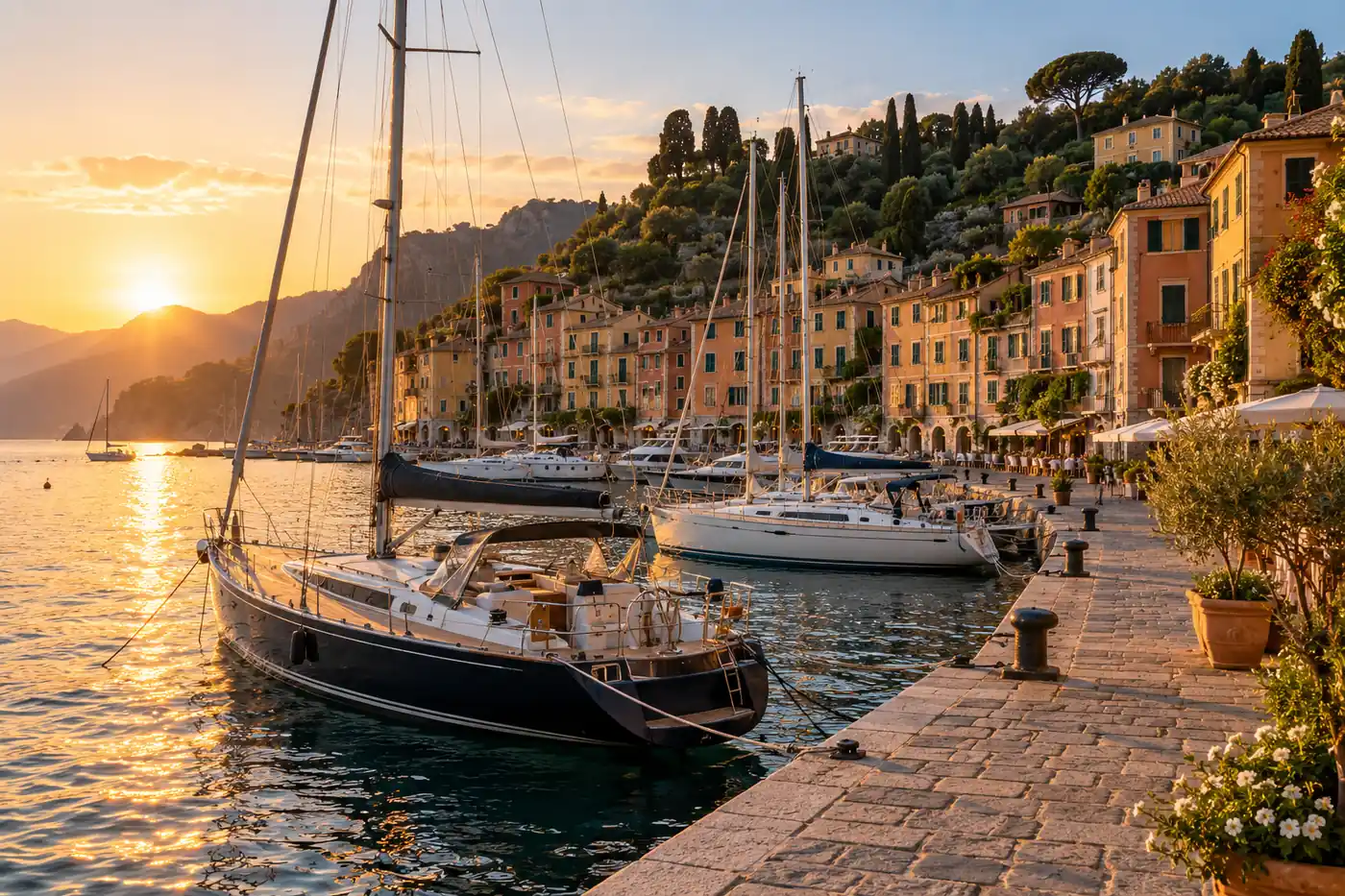
The asking price is only the start. VAT comes first, and in Italy it depends on who is selling. The standard rate is 22 percent, according to the Agenzia delle Entrate page on general VAT rules and rates, last updated in December 2020, and the guide “Nautica & Fisco Dogane” of 2023, published by the Agenzia delle Entrate, the customs agency ADM and Confindustria Nautica, applies it to a used pleasure boat sold by a VAT-registered seller unless a special regime fits. The margin scheme charges VAT only on a trader’s margin, and applies when the trader bought the boat from a private person, from another margin-scheme seller or from a seller who could not deduct the VAT. For VAT a boat counts as used when it is longer than 7.5 m, has been registered for more than 3 months and has sailed more than 100 hours, according to the KPMG guide, which states the position at 31 October 2020.
When the seller is a private person, the sale carries no VAT and registration tax applies instead: the 2023 guide lists EUR 404 up to 8 m, EUR 607 up to 12 m, EUR 809 up to 18 m and EUR 1,011 above 18 m. Ask the seller to say in writing which case applies, and compare two offers only when each says so.
For a boat already in the EU, the buyer’s task is to see proof that VAT was paid. A YACHT article of 7 February 2022 says a private sale of an EU-built boat that has not left the EU for over 3 years should be backed by the purchase contract with proof of payment and a few recent mooring and maintenance invoices, and that an original invoice showing VAT, with proof of payment, can prove Union status, which is lost after more than 3 years outside the EU. Ask for those papers before you pay a deposit.
A buyer from outside the EU who takes the boat out of the Union buys without VAT: a sale with transport to a non-EU territory is non-taxable under Article 8 of Decree 633/1972. The 2023 guide requires a transfer of ownership, the boat leaving the EU customs territory, carried by the seller or by the non-resident buyer within 90 days of delivery, and proof of export tied to the customs document. Ask the seller to hand over that proof.
Registration has its own costs. The Guardia Costiera lists the pagoPA fees for entering a boat in the ATCN and obtaining the navigation licence, and the items add up to EUR 180.00 for a boat with no safety certificate, which is our sum of the listed items. The annual tax on owning a pleasure boat was abolished by the 2016 Stability Law.
The berth is the large variable. Marina di Portoscuso in Sardinia, with 395 berths for boats up to 25 m, charges EUR 3,485 a year for 10.01 to 12 m and EUR 4,940 for 12.01 to 15 m, VAT excluded, from 1 January 2026. At Porto Cervo the Porto Nuovo price list for 2026 puts the 12 m class at EUR 15 a day from 1 January to 31 March and EUR 203 a day from 10 July to 5 September, VAT included, while the Porto Vecchio has no published list. A port operator acting as a business charges VAT at 22 percent on a mooring service for a private boater, so ask each marina to price your berth in writing. Third-party liability insurance is compulsory for motor-equipped recreational boats, so ask an insurer for a quote on the specific boat.
What we do: we handle enquiries and negotiations in your language, and the head office coordinates with a local broker, so the questions on VAT, registration tax and berth go to the seller and the marina in writing and the answers reach you before you make an offer.

Stage one: offer, deposit and contract. Once the offer and the sale terms are agreed, the buyer pays a 10 percent deposit into escrow, and the balance goes to the seller when the contract conditions are met. Those conditions should name the VAT or registration tax position, the title and registry papers and the survey result, so you are not committed before you know the boat. What we do: a lawyer prepares the sale contract, and we ask that it carry the document list and the survey condition.
Stage two: tax and customs status. For a boat that stays in the EU, ask for the invoice and proof of payment described above. For a boat arriving from outside the EU, the customs route is temporary admission, with a maximum of 18 months for a privately used boat, according to the KPMG guide, the 2023 guide and Noonsite. Total relief applies to a boat registered outside the EU in the name of a person established outside the EU, and under partial relief the duty due is 3 percent for each month or part month, with VAT paid in full. Ask customs in writing which rule covers your boat, and keep the answer with the boat’s papers. What we do: the head office puts that question through the local broker, and the route is chosen before you pay.
Stage three: flag, category and arrival. Decree 171/2005, the Codice della nautica da diporto, sorts craft by hull length: a “natante” is 10 m or less, an “imbarcazione” is longer than 10 m and up to 24 m, and a “nave” is longer than 24 m. Ask the Guardia Costiera in writing how a foreign-flag boat kept in Italy is treated before you decide on the flag. A boat arriving by sea from outside the Schengen area must check in at a border crossing point, according to Noonsite, and a foreign-flag boat obtains the arrival document, the “costituto”, from the maritime authority of the first Italian port. What we do: we settle the flag and the arrival port with you before the deposit, in your language.
Stage four: registration in the ATCN. The application goes to any Sportello Telematico del Diportista (STED) or online through Il Portale dell’Automobilista, according to the Guardia Costiera page on entering a boat in the ATCN, updated on 11 February 2026, and the register states 60 days from a complete application. The documents include the STED form in stamp paper, the title of ownership, the EU declaration of conformity and an engine power declaration, and for a boat from another EU register a cancellation certificate. A foreign owner with no domicile in Italy must elect domicile with the consular authority of the owner’s State or with a representative domiciled in Italy, and documents not in Italian need legalisation, or an apostille, and a certified Italian translation. Under Article 17 of Decree 171/2005, a transfer of ownership is made public within 60 days of the deed, or 120 days if a party lives abroad. What we do: a lawyer prepares the sale contract, and the head office coordinates the file with the local broker so the originals are ready before the sale closes.
Stage five: insurance and handover. Insurance is arranged before you sail. At handover, collect the title and registry papers, the declaration of conformity, the service history and the manuals. What we do: a sea trial can be arranged at your expense before the balance is paid to the seller.
| Item | Figure | Applies to, and whose figure |
|---|---|---|
| Standard VAT rate | 22 percent | Italy; Agenzia delle Entrate, page updated 12 December 2020 |
| Boat counts as used for VAT | over 7.5 m, registered over 3 months, sailed over 100 hours | KPMG guide, position at 31 October 2020 |
| Registration tax on a private sale, boat up to 12 m | EUR 607 (EUR 404 up to 8 m; EUR 809 up to 18 m) | "Nautica & Fisco Dogane" guide, 7th edition, 2023 |
| Export by a non-EU buyer, deadline | 90 days from delivery | Same guide, indirect export |
| Temporary admission, privately used non-EU boat | 18 months | KPMG guide and the 2023 guide; Noonsite |
| ATCN registration time | 60 days from a complete application | Guardia Costiera page, updated 11 February 2026 |
| ATCN fees, boat with no safety certificate | EUR 180.00 | Sum of the items on the Guardia Costiera page, updated 11 February 2026 |
| Transfer made public | 60 days from the deed; 120 days if a party lives abroad | Article 17, Decree 171/2005, text in force from 10 May 2026 |
| Annual berth, 10.01 to 12 m, Portoscuso | EUR 3,485, VAT excluded | Marina di Portoscuso, valid from 1 January 2026 |
| Daily berth, 12 m class, Porto Cervo | EUR 15 (1 January to 31 March); EUR 203 (10 July to 5 September), VAT included | Marina di Porto Cervo, 2026 |
Figures as of 28 October 2026 unless dated, from the sources listed below.
Use the table against the boat you are looking at. The VAT or registration tax position comes first, because it changes the price. The 60-day registration period runs on the register’s side, so the documents and translations should be ready before the sale closes.
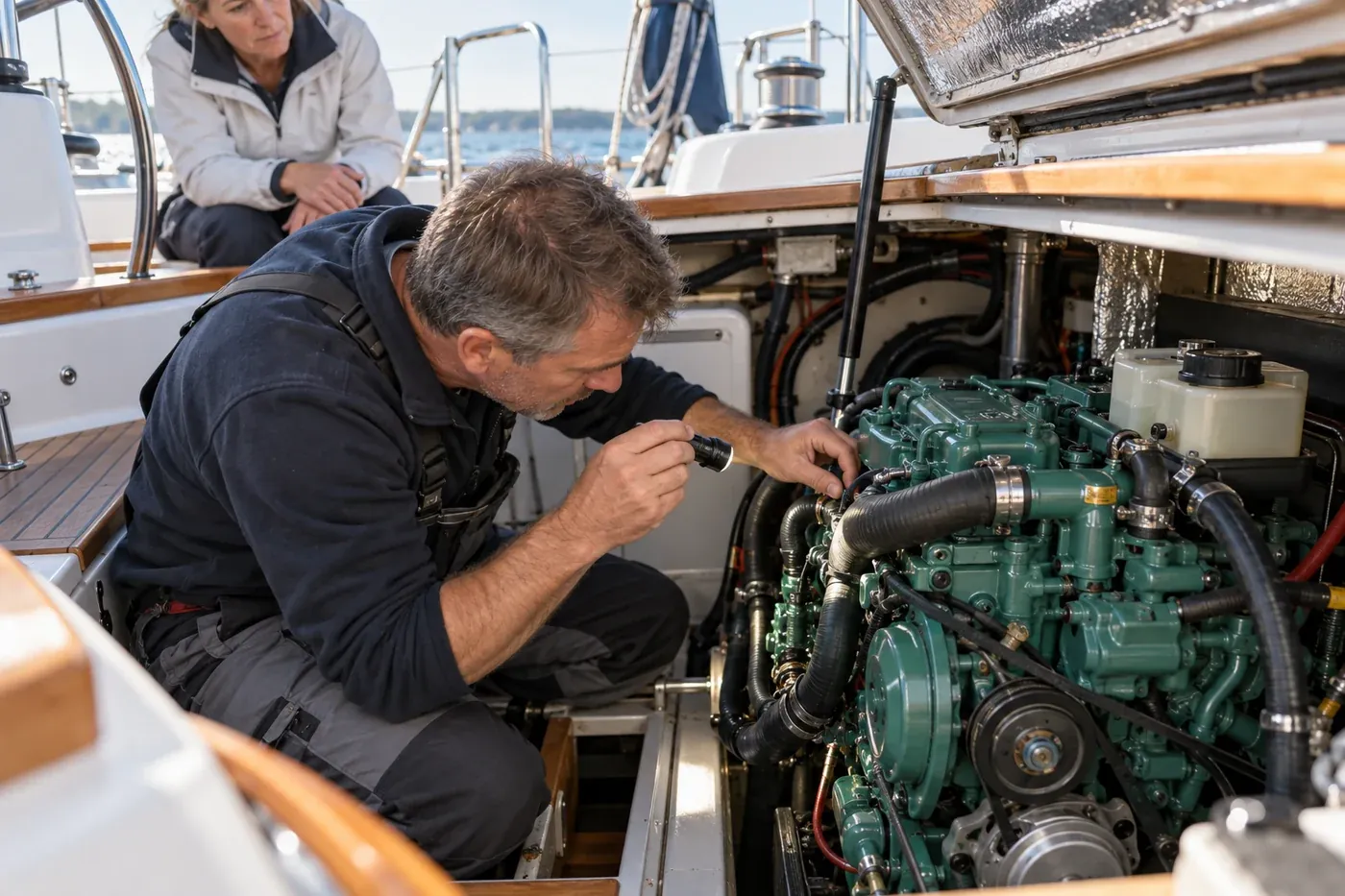
A used boat in Italy is judged on its register entry, its papers and its survey. The Ministry of Infrastructure explains that a historical search of a boat in the ATCN, including administrative detentions, can be made at any STED, and that the central conservatory office verifies registrations and annotations, including security interests. Ask the seller to authorise that search, or have your lawyer request it, before any deposit is paid.
Ask also whether the boat was ever used for hire or charter. Commercial use is recorded in the ATCN as “commercial yacht” and annotated on the navigation licence, and Article 19 of Decree 171/2005 provides for a change from commercial to private use. The KPMG guide counts hire and charter as commercial use and places the sale of such a boat under a different VAT regime, so a boat with a commercial history needs its VAT position explained in writing.
Appoint your own surveyor, independent of the seller and of any broker, and agree in the contract what happens to the findings: a price reduction, repair before delivery, or the right to withdraw. Ask for a lift-out, so that hull, keel, rudder and running gear are inspected out of the water, and compare engine hours with the service records. A seller who cannot produce the declaration of conformity and the engine power declaration that registration asks for should not receive a deposit.
Ask about haul-out by name. Cantiere Nautico Polaris in Marsala has a travel lift of up to 70 tonnes, Nautica Cala Galera has lifts of 40, 70 and 320 tonnes for boats up to 50 m, and the shipyard at Marina di Capitana has a 60-tonne lift. Ask each yard for the capacity, the date and the price in writing.
What we do: a survey, haul-out and sea trial can be arranged at your expense, and the head office coordinates them with the local broker.

We act for the buyer. The head office coordinates the purchase with a local broker, a lawyer prepares the sale contract, and you pay a 10 percent deposit into escrow after the offer and sale terms are agreed, then the balance to the seller when the contract conditions are met. A survey, haul-out and sea trial can be arranged at your expense. We handle enquiries, viewings and negotiations in your language, so you deal with one office instead of a chain of them.
We know where a purchase stalls, and in Italy that is the VAT or registration tax question, the register entry and the foreign owner’s papers. You can see current listings among our boats for sale in Italy, a hub that covers 151 marinas across 15 regions, or by region: boats for sale in Sardinia, boats for sale in Liguria, boats for sale in Sicily and boats for sale in Tuscany. Our page on yacht brokers in Italy sets out how we work there.
Tell us the boat, or the kind of boat, you are considering, and we will explain how we would approach it and what our involvement as your broker would include. Write to info@europeanyachtbrokers.com.

Peter Mattey
Yacht Broker, European Yacht Brokers, Olbia (Sardinia) office
Via Capoverde 2, c/o Delta Center, 07026 Olbia, Sardinia, Italy
+39 351 949 3538
info@europeanyachtbrokers.com
Check four things before you agree a price. First, who is selling and which tax applies: a VAT-registered seller charges 22 percent unless the margin scheme or another regime fits, and a private seller charges no VAT but the sale carries registration tax. Second, proof of VAT status for a boat in the EU, or proof of export if you are buying from outside the EU. Third, the register: a historical ATCN search, the title of ownership and the declaration of conformity. Fourth, an independent survey with a lift-out. A seller slow to produce these papers is telling you something. We coordinate these checks with the local broker.
It depends on the seller. A VAT-registered seller charges the standard 22 percent unless the margin scheme or another regime applies, and the margin scheme charges VAT only on the trader’s margin. A private seller charges no VAT, and registration tax applies instead, EUR 607 for a boat up to 12 m according to the 2023 guide. A buyer from outside the EU who takes the boat out of the Union buys without VAT, with proof of export. Ask the seller in writing which case applies. We put the question to the seller through the local broker and negotiate in your language.
Yes, a foreign owner can apply, with conditions. The register states 60 days from a complete application, made at any STED or online through Il Portale dell’Automobilista. A foreign owner with no domicile in Italy must elect domicile with the consular authority of his or her State or with a representative domiciled in Italy, and documents not in Italian need legalisation, or an apostille, and a certified Italian translation. A deed drawn up by a foreign notary must first be deposited with a notary practising in Italy. Ask the Guardia Costiera to confirm your case in writing. We coordinate these questions with the local broker.
Yes, for motor-equipped recreational boats navigating in waters of public use. Article 123 of the Private Insurance Code requires third-party liability insurance and extends the duty to removable engines of any power. Article 125 applies the obligation to foreign-registered boats staying temporarily in Italian waters, for the length of their stay. The Royal Yachting Association advises carrying an Italian translation of the insurance document, with the serial number of any tender or outboard. Ask an insurer for a quote on the specific boat, and for the minimum cover the law requires, before you commit.
Price each item in writing before you commit. Italy has no annual tax on owning a pleasure boat, since the 2016 Stability Law abolished it. At Marina di Portoscuso an annual berth for a boat of 10.01 to 12 m costs EUR 3,485, VAT excluded, in tariffs valid from 1 January 2026, and the slipway charges EUR 15 for each launch or haul-out. Daily rates at Porto Cervo vary from EUR 15 to EUR 203 for the 12 m class. Add liability insurance, and ask each marina for its current tariff when you start buying a boat in Italy. We handle those enquiries for you, in your language.
Yes, an independent survey belongs in every purchase of a used boat, and when buying a boat in Italy it also helps to know what the register asks for. Registration needs the EU declaration of conformity, or an attestation from a notified body for a boat without CE marking, and an engine power declaration. A historical search in the ATCN shows security interests and administrative detentions. Appoint a surveyor independent of the seller and of any broker, ask for a lift-out and agree what happens to the findings. We can arrange the survey, haul-out and sea trial at your expense.
Facts retrieved and read on 28 October 2026. Author: European Yacht Brokers.