SPYRO
RIVA SUPER OPERA 85 About SPYRO Introducing the 25.9-meter motor yacht SPYRO, a stunning Riva 85 Opera crafted in Italy by the prestigious Riva shipyard.
THE EYB COUNTRY GUIDES · Portugal
Match your command certificate to the planned navigation and check training, foreign recognition, current tariff entries and renewal requirements.
By Peter Mattey · 9 min read · Facts checked 2026-10-03
Boat licence Portugal is often used to mean the skipper's command qualification, which is separate from the boat's registration and navigation classification. The Portuguese recreational regime sets certificate categories, permitted command areas and routes for recognised foreign qualifications. This guide explains the verified rules, current authority tariff entries and renewal provisions, with practical recommendations for choosing the appropriate application. It does not assume every foreign certificate qualifies or turn a course advertisement into an official authority price.
Buyers should resolve who can command the intended boat before planning delivery, while owners should check the validity of the certificate they already hold. Compare your personal qualification with the proposed navigation and the boat's records. Ask DGRM about an uncertain foreign title or eligibility question before relying on it. For anything this guide does not cover, email us at info@europeanyachtbrokers.com for the latest information.
Key facts at a glance
Article 35 requires command by a person with an appropriate recreational qualification or eligible registered-seafarer status. (Consolidated text last amended 13 October 2020.)
Diário da República ·The patrão local qualification permits command within sight of the coast, no more than 25 miles from a shelter port and six miles from the coast under Article 35. (Consolidated text last amended 13 October 2020.)
Diário da República ·Article 39 automatically recognises certificates or equivalents issued by EU Member State administrations without requiring issue of a corresponding Portuguese certificate. (Consolidated text last amended 13 October 2020.)
Diário da República ·Annex III lists renewal, second copy and the national-equivalence regime at €47.90. (Order 12/DG/2026, dated 18 February 2026, effective 1 March 2026.)
DGRM – DGRM 2026 tariff, visually checked in the off ·Article 37 requires renewal from age 70 every five years and from age 80 every two years. (Consolidated text last amended 13 October 2020.)
Diário da República ·Section 1
Article 35 requires a recreational boat to be commanded by a person with an appropriate recreational qualification or the relevant eligibility as a registered seafarer. Ownership alone is not the command qualification described by the statute. As a practical recommendation, identify who will actually command the boat during delivery and later use, then compare their certificate with the intended navigation. Keep the boat's classification and the person's qualification as separate checks rather than assuming a suitable boat record authorises any owner to command it.
The coastal qualification (patrão de costa) permits command up to 40 miles from the coast. The local qualification (patrão local) permits command within sight of the coast, up to 25 miles from a shelter port and six miles from the coast. These are certificate conditions, not recommended passage plans. As a practical recommendation, write down the journeys you intend and ask DGRM about any part that does not fit the documented qualification before commissioning delivery or choosing a training route.
The offshore qualification (patrão de alto-mar) permits command without an area limit under the article. That scope does not remove the need to check the boat's own permitted navigation or the practical ability to undertake the voyage safely. As a practical recommendation, compare the certificate, boat record and actual passage separately, and obtain appropriate instruction for unfamiliar systems or handling. This guide does not rank qualifications by a boat's asking price or assume a certificate guarantees experience in every vessel and weather condition.
Broker tip: Compare the commander's certificate with the intended route and the boat's separate navigation classification. Resolve an uncertain limit with DGRM before committing to a delivery arrangement or a course chosen for the wrong scope. See also our guide on what safety equipment a boat must carry in Portugal.
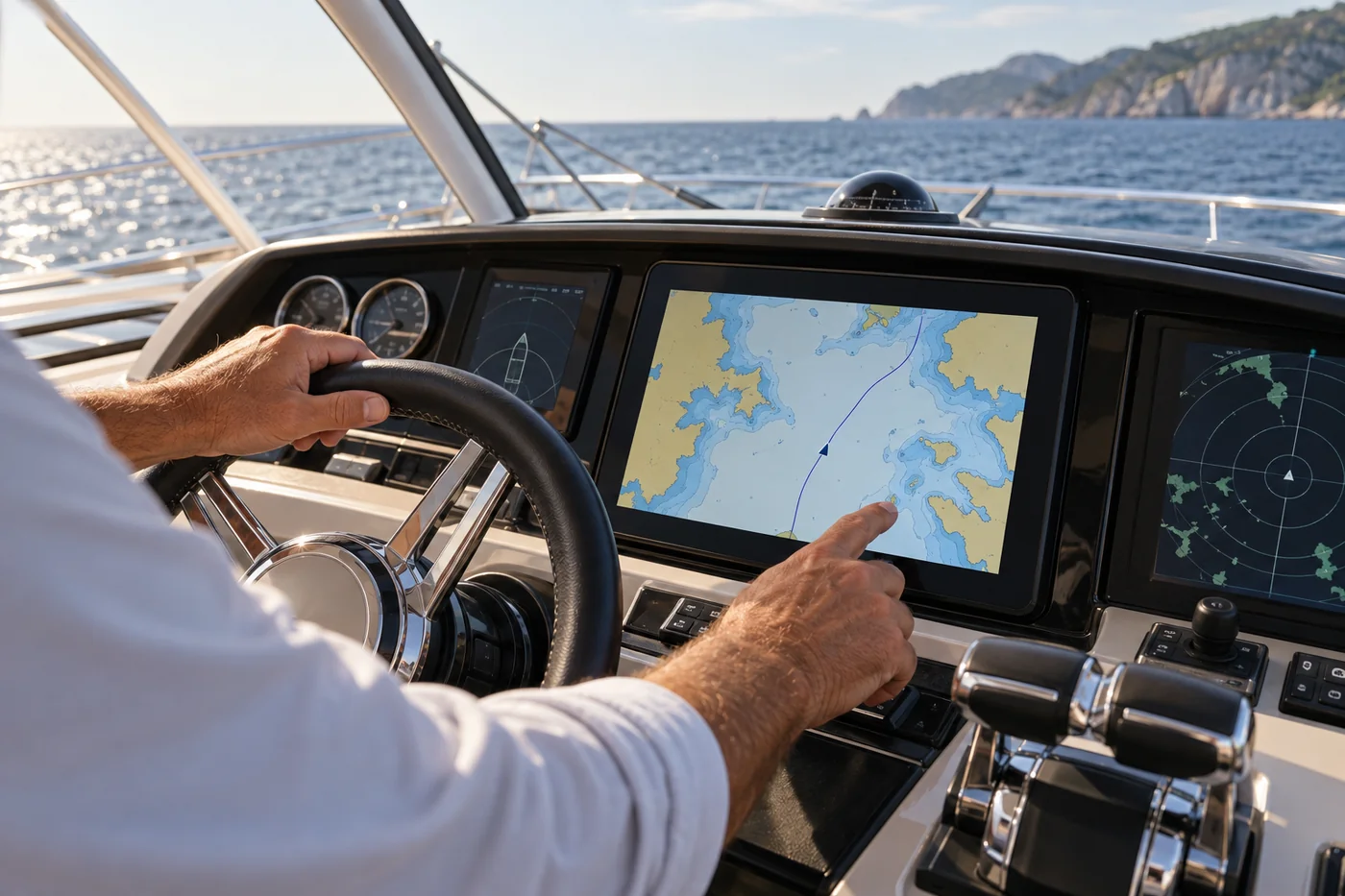
Skipper hands on a chart plotter at the helm.
Appropriate command qualification
Section 2
Article 40 identifies the nautical higher-education institution (ENIDH), FOR-MAR and other entities accredited by DGRM as competent recreational training providers. As a practical recommendation, check the provider's current authority accreditation for the course you intend and ask what the quoted package includes. Do not treat a training price as the authority's examination or issue fee without an itemised explanation. Keep the chosen category, required training and evaluation route clear before enrolling, particularly if another certificate or previous professional training may be relevant.
Article 38 provides an examination-exempt issue route for holders of valid certificates from third-country administrations when analogous issue conditions are proved. DGRM directs equivalence requests through BMar under Náutica de Recreio and Equiparação. As a practical recommendation, supply the actual valid certificate and evidence of the conditions under which it was issued. Ask which route applies before assuming a private qualification or an expired title meets the provision, and retain the authority's explanation alongside the application records.
Article 39 separately provides automatic recognition of certificates or equivalents issued by EU Member State administrations, without issue of a corresponding Portuguese certificate. This is a scoped legal rule, not a statement that every document issued by an organisation in Europe is automatically recognised. As a practical recommendation, confirm the issuing administration, title category and relevant scope from the actual certificate. Ask DGRM about an uncertain issuer or document rather than substituting geographical location for the statutory administrative-issue condition.
Broker tip: Check the issuing administration and title validity before choosing recognition or equivalence. For training, verify provider accreditation and request an itemised course scope, keeping its price separate from authority examination and issue entries. Readers often go on to our guide on what boat insurance you need in Portugal.

Ship compass resting on a navigation chart.
Qualified training providers
Buying or selling a boat in Portugal and want a second opinion? Speak to one of our brokers.
Section 3
Annex III of the current DGRM tariff lists renewal, second-copy issue and the national-equivalence regime at €47.90. It separately lists equivalence of a certificate issued by a third-country administration at €101.50. These are defined authority entries, not a total for every applicant's training and documents. As a practical recommendation, confirm which service you need and the applicable amount on the authority invoice before payment, particularly where a different format or an additional step forms part of the requested arrangement.
The tariff lists recognition of a certificate or equivalent document issued by a third-country administration at €47.90. Recognition and issue through equivalence are distinct entries, so the smaller amount should not automatically be substituted for the other route. As a practical recommendation, ask DGRM to identify the correct request for your actual certificate before budgeting. Keep the application evidence and payment record together, and clarify what result will be issued so a declaration is not mistaken for a different certificate or category.
For examinations through training or renewal, with certificate issue following approval, Annex III lists €220.70 for patrão de alto-mar or patrão de costa and €137.30 for patrão local, marinheiro or marinheiro júnior. As a practical recommendation, ask whether the training provider's quote includes the relevant authority amount and which other costs remain. No typical private course price or complete medical-document budget is established here. Use confirmed quotations for those separate items rather than adding an invented national average. No current private training-course price, typical completion time or complete medical-document cost was verified. No individual foreign certificate's recognition or equivalence outcome was determined. For these, email us at info@europeanyachtbrokers.com for the latest information.
Broker tip: Ask DGRM which tariff entry applies to the actual request, then check the invoice. Obtain separate course and document quotations, making sure the training offer states whether the authority examination and issue amount is included. Our guide on how to register a boat in Portugal covers a related point.
Skipper licence certificate on a table.
Renewal tariff entry
Annex III lists renewal, second copy and the national-equivalence regime at €47.90. (Order 12/DG/2026, dated 18 February 2026, effective 1 March 2026.)
Source: DGRM – DGRM 2026 tariff, visually checked in the offAnnex III lists equivalence of a certificate issued by a third-country administration at €101.50. (Order 12/DG/2026, dated 18 February 2026, effective 1 March 2026.)
Source: DGRM – DGRM 2026 tariff, visually checked in the offAnnex III lists recognition of a third-country administration certificate or equivalent document at €47.90. (Order 12/DG/2026, dated 18 February 2026, effective 1 March 2026.)
Source: DGRM – DGRM 2026 tariff, visually checked in the offAnnex III lists training-route or renewal exams with certificate issue on approval at €220.70 for patrão de alto-mar or patrão de costa and €137.30 for patrão local, marinheiro or marinheiro júnior. (Order 12/DG/2026, dated 18 February 2026, effective 1 March 2026.)
Source: DGRM – DGRM 2026 tariff, visually checked in the offSection 4
Article 37 requires renewal from age 70 every five years and from age 80 every two years. It requires the request 30 days before validity ends. DGRM's service explains that renewal is handled before the birthday on which the certificate ceases to be valid. As a practical recommendation, review the actual title and applicable renewal position well before planning a voyage; do not assume an old printed date or a pending request alone settles the current validity of the qualification.
The DGRM renewal service asks for a physical-fitness medical certificate issued less than six months earlier or the specified seafarer medical certificate. As a practical recommendation, prepare the applicable medical evidence and other requested records before submission, and ask how they should be supplied in your circumstances. Keep the submitted application and any request for clarification together. A medical appointment, renewed insurance or a boat inspection should not be treated as a substitute for completion of the separate command-certificate renewal procedure.
Article 37 also requires identity, residence or eligibility changes to be notified to DGRM within 90 days. It permits renewal after expiry subject to a successful examination requested through DGRM. As a practical recommendation, check a title's status before commanding the boat and ask the authority about an expired certificate rather than relying on an assumption that routine renewal remains available. Record any changed details promptly, and retain the issued evidence so the person's qualification can be checked separately from the vessel's documents.
Broker tip: Check renewal timing and required medical evidence before arranging a passage. Resolve an expired title with DGRM, keep personal details current and retain the issued qualification evidence alongside the boat's separate onboard documents. A related question is answered in our guide on how to buy a boat in Portugal.

Mooring line and fenders on a marina berth.
Age-based renewal intervals
Practical support
Peter Mattey is a yacht broker at European Yacht Brokers with a BA in Law. He is not a Portuguese lawyer: for Portuguese law and tax we refer you to a locally qualified adviser. What we can do is help you plan the transaction, put the right questions to the other side and spot gaps in the paperwork before you commit.
If you are buying or selling a boat in Portugal, tell us about the boat and the area through the enquiry form on this page and a broker will reply. For anything this guide does not cover, email us at info@europeanyachtbrokers.com for the latest information.

Written by
Peter Mattey
Yacht Broker, European Yacht Brokers
BA (Law). Expert in marine law

The handover of a boat at the dock.
Your questions
No: Article 35 requires an appropriate recreational command qualification or the relevant registered-seafarer eligibility. Check the actual commander's title separately from ownership and the boat's registration. As a practical recommendation, compare the certificate with the planned route before agreeing delivery, and ask DGRM about an uncertain category, foreign title or scope rather than assuming a purchase establishes permission to command. (Diário da República)
Article 35 permits patrão local command within sight of the coast, up to 25 miles from a shelter port and six miles from the coast. Compare that qualification scope with your intended navigation and with the boat's own classification. These are statutory certificate conditions rather than a recommended itinerary, so resolve a route outside the documented scope with DGRM before planning the passage. (Diário da República)
No such blanket rule is stated here: Article 39 refers specifically to certificates or equivalent documents issued by EU Member State administrations. Confirm the actual issuer and document before relying on that scope. Third-country titles have separate recognition or equivalence conditions, so ask DGRM about an uncertain certificate and supply its valid records rather than using the issuer's location as the only check. (Diário da República)
No: Annex III of the 2026 DGRM tariff lists third-country recognition at €47.90 and third-country certificate equivalence at €101.50. Ask the authority which defined request applies to your actual title and check the invoice. Those amounts are authority service entries, not a complete budget for private instruction, medical evidence or other document preparation required in an individual case. (DGRM)
Article 37 permits renewal after expiry subject to successful examination requested through DGRM, so ordinary renewal should not be assumed for an expired title. The regular age-based rules require renewal from 70 every five years and from 80 every two years, with the request before expiry. Confirm the actual status and required medical evidence with the authority before relying on the certificate for a voyage. (Diário da República)
This guide only includes facts checked against official sources. For anything it does not cover, email us at info@europeanyachtbrokers.com for the latest information, and ask a locally qualified adviser to confirm the position for your own boat.
Ready when you are
RIVA SUPER OPERA 85 About SPYRO Introducing the 25.9-meter motor yacht SPYRO, a stunning Riva 85 Opera crafted in Italy by the prestigious Riva shipyard.
Check it yourself
Current recreational boating regime: registration, navigation classifications, certification, insurance and command qualifications.
Qualification-equivalence requests, documents and the BMar request type.
Renewal application, validity ages, required medical evidence and submission route; service-page fees not used where stale.
DGRM 2026 tariff, visually checked in the official PDF: Annex III recreational inspection and technical-information charges.
Keep reading
Talk to European Yacht Brokers
Buying or selling a boat in Portugal? Tell us what you need
Tell us about the boat, your budget and the area and a broker will reply.