
LADY LARISA
SANLORENZO SX88 Built by Sanlorenzo in 2018, LADY LARISA combines contemporary Italian design with versatile living spaces and a seamless connection to the water. Exterior
THE EYB COUNTRY GUIDES · Italy
Required gear by distance from the coast, permitted substitutes, approval standards and exemptions, with the official source for every figure.
By Peter Mattey · 9 min read · Facts checked 2026-10-01
The required boat safety equipment Italy depends directly on the distance a vessel operates from the coast. For navigation within 300 metres, Annex A does not mark any mandatory equipment entry, but operators and passengers of boards, derives, kitesurf and personal watercraft are still required to wear a CE-marked category-50 flotation device, meeting amended ISO standards. A vessel within 1 nautical mile must carry category-100 lifejackets for all and, if over 7 metres, display a black anchor ball; a bilge pump or suitable tool must also be on board, but neither flares nor liferaft are listed as mandatory.
Operating within 3 nautical miles introduces the need for a lifebuoy with line, a smoke signal, two hand flares, COLREG lights and, depending on the category, a parachute rocket is not mandatory. Beyond this, equipment obligations increase by distance, requiring additional flares, upgraded lifejackets, lifebuoy lights and, for offshore, a liferaft, barometer and first-aid kit as listed in Annex A. The guide continues with Boat safety equipment Italy: required gear by distance from the coast, the rules that apply at any distance and permitted substitutes, Boat safety equipment Italy: approval standards, as well as exemptions, tenders and fire extinguishers.
Key facts at a glance
Within 300 metres of the coast, Annex A of the Italian safety-equipment table marks no equipment as mandatory.
Gazzetta Ufficiale, Allegato V (21 Sep 2024) · 2026-10-01Navigating within 6 nautical miles requires category-100 lifejackets for all on board, a lifebuoy with line and light, and a bilge pump or tool.
Gazzetta Ufficiale, Allegato V (21 Sep 2024) · 2026-10-01Unlimited navigation requires a full liferaft, category-150 lifejackets for all, an EPIRB, VHF and GPS.
Gazzetta Ufficiale, Allegato V (21 Sep 2024) · 2026-10-01A hand flare may be replaced by an LED device that conforms to SOLAS MED rules.
Gazzetta Ufficiale, Allegato V (21 Sep 2024) · 2026-10-01For non-CE natanti one fire extinguisher is required: 13 B up to 18.4 kW, 21 B up to 147 kW, 34 B above 147 kW.
Gazzetta Ufficiale, Allegato V (21 Sep 2024) · 2026-10-01Section 1
Requirements for boat safety equipment Italy change with distance from the coast. Within 300 metres of shore, Annex A does not mark any equipment as mandatory, apart from category-50 flotation worn at all times for boards, derives, kitesurf and personal watercraft. For boats operating within 1 nautical mile, category-100 lifejackets are required for everyone on board, together with a black anchor ball if the vessel exceeds 7 metres. A bilge pump or a suitable tool is also required; flares and a liferaft are not noted as mandatory at this distance.
As distance from the shore increases, the list develops. Within 3 nautical miles, category-100 lifejackets remain compulsory for everyone, and a lifebuoy with a line joins the list. One smoke signal, two hand flares, the correct COLREG lights and a bilge pump or a suitable tool must all be carried. Parachute rockets do not appear in the mandatory equipment for this distance.
For vessels operating within 6 nautical miles, the boat safety equipment Italy rules require the same category-100 lifejackets for each person aboard, joined by a lifebuoy with both line and light, two smoke signals, two hand flares and two parachute rockets. COLREG lights and a bilge pump or tool are necessary, and this distance zone is generally applicable. From 12 nautical miles out, the list shifts to coastal liferafts, category-150 lifejackets for everyone, two smoke signals, two hand flares and two parachute rockets, adding VHF radio. For imbarcazioni, a compass with a deviation table is required at this distance.
Once further offshore, within 50 nautical miles, the compulsory equipment includes a full liferaft, category-150 lifejackets for all, two smoke signals, two hand flares and two parachute rockets. VHF and GPS must both be on board, and both a barometer and first-aid kit appear in the annex for this distance. EPIRB is not marked as required within this band.
Beyond these limits, for unlimited voyages, a full liferaft and category-150 lifejackets continue to be needed for all aboard, together with lights, a lifebuoy with line and light, two smoke signals, three hand flares and three parachute rockets. EPIRB, VHF and GPS become standard, with barometer and first-aid kit listed in Annex A. In all cases, inland waters require category-100 lifejackets for each person and a lifebuoy with line. The obligations for boat safety equipment Italy are set out strictly by these distance bands, helping owners maintain their vessel in line with the stipulations. A related question is answered in our guide on whether you need a boat licence in Italy.
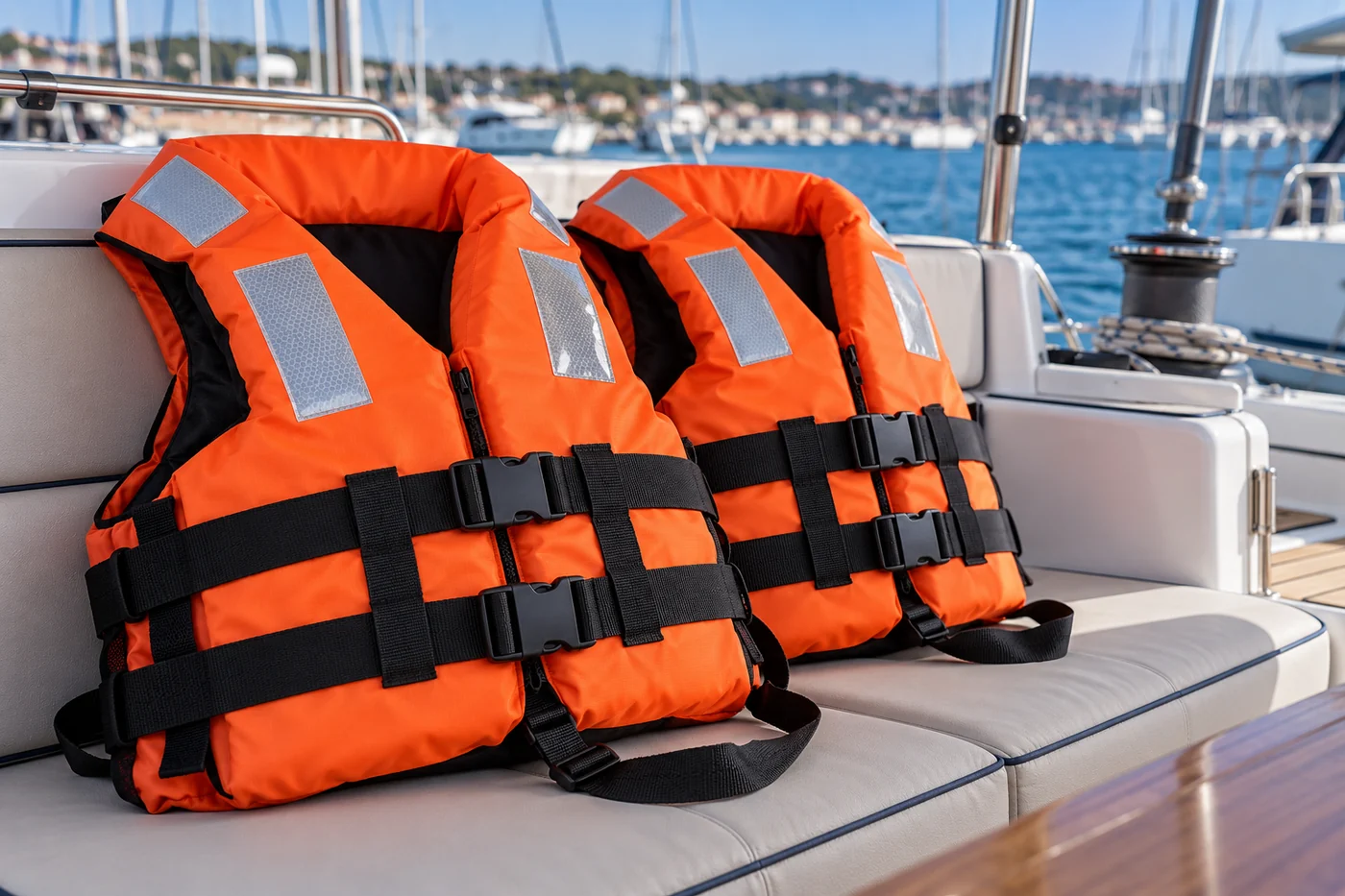
Lifejackets stowed on board.
Equipment by navigation limit
| Navigation limit | Equipment marked in Annex A | Notes |
|---|---|---|
| Unlimited | Full liferaft; category-150 lifejackets for all; lights; lifebuoy with line and light; two smoke signals; three hand flares; three parachute rockets; EPIRB, VHF and GPS | Annex A also lists a barometer and a first-aid kitSource: Gazzetta Ufficiale, Allegato V (21 Sep 2024) · |
| Within 50 nm | Full liferaft; category-150 lifejackets for all; two smoke signals; two hand flares; two parachute rockets; VHF and GPS | No EPIRB mark in the table; barometer and first-aid kit also listedSource: Gazzetta Ufficiale, Allegato V (21 Sep 2024) · |
| Within 12 nm | Coastal liferaft; category-150 lifejackets for all; two smoke signals; two hand flares; two parachute rockets; VHF | Compass and deviation table for imbarcazioniSource: Gazzetta Ufficiale, Allegato V (21 Sep 2024) · |
| Within 6 nm | Category-100 lifejackets for all; lifebuoy with line and light; two smoke signals; two hand flares; two parachute rockets; COLREG lights; bilge pump or tool | Applies generallySource: Gazzetta Ufficiale, Allegato V (21 Sep 2024) · |
| Within 3 nm | Category-100 lifejackets for all; lifebuoy with line; one smoke signal; two hand flares; COLREG lights; bilge pump or tool | Parachute rockets not marked mandatorySource: Gazzetta Ufficiale, Allegato V (21 Sep 2024) · |
| Within 1 nm | Category-100 lifejackets for all; black anchor ball for units over 7 m; bilge pump or tool | Flares and liferaft not marked mandatorySource: Gazzetta Ufficiale, Allegato V (21 Sep 2024) · |
| Within 300 m | No equipment entry is marked mandatory in Annex A | The always-worn category-50 flotation rule for boards, derives, kitesurf and personal watercraft still appliesSource: Gazzetta Ufficiale, Allegato V (21 Sep 2024) · |
| Inland waters | Category-100 lifejackets for everyone and a lifebuoy with line | Marked mandatory in Annex ASource: Gazzetta Ufficiale, Allegato V (21 Sep 2024) · |
Swipe to see all columns →
Section 2
Rules for boat safety equipment Italy apply consistently regardless of the distance from shore in certain areas. For operators and passengers of sailing boards and derives, kitesurf, personal watercraft and similar units, it is required to permanently wear a CE-marked category-50 personal flotation device that meets the latest amended ISO standards, whatever the distance covered. During solo night navigation, a lifejacket must always be worn as an ongoing precaution, marking this requirement as constant, not subject to change by location or proximity to land.
Sailing vessels have additional requirements for deck safety harnesses and safety lines. Their quantity depends on the voyage: two are required for operations setting out to unlimited distances and up to 50 nautical miles from the coast, while one is needed for passages up to 12 nautical miles. There is no mandatory provision for deck safety harnesses at shorter bands than these distances. Flexibility is given, as these harnesses may be integrated with the lifejacket or another certified personal protection device, allowing choice in how compliance is achieved for boat safety equipment Italy.
For safety navigation instruments, the rules permit up-to-date technological alternatives, making it practical whether travelling near or far from shore. A magnetic compass may be replaced by an electronic compass when preferred, as long as it meets regulations. Nautical charts, another vital navigation aid, may be substituted with electronic cartography, provided it is compliant with the Ministry of Infrastructure and Transport decree published in Gazzetta Ufficiale n. 193 of 19/08/2002. When it comes to chart deviation, the compass deviation table requires updating only after changes to apparatus or after structural modifications that could create magnetic deviations, so routine updates are not demanded unless specific changes occur.
Additional equipment also permits modern substitutes. The hand flare, for example, can be replaced with an LED signalling device if it conforms to SOLAS MED rules in line with the amended IMO standards. Where an EPIRB is required, it is also allowed to carry a satellite telephone featuring a distress-message device that contacts the IMRCC and is compliant with D.Lgs. 128 of 22 June 2016 or DPR 239 of 20 December 2017 and adheres to EN 60945. A bell, if part of the equipment, may be replaced by a portable sound device under the same regulatory conditions. These allowances accommodate advances in technology without compromising legal obligations for onboard safety at any distance. See also our guide on what boat insurance you need in Italy.

Distress flares carried on board.
Rules at any distance and permitted substitutes
Buying or selling a boat in Italy and unsure what must be on board? Speak to one of our brokers.
Section 3
The approval standards governing boat safety equipment Italy demand attention to detail across several categories. Liferafts must be approved under Ministerial decree of 12 August 2002, n. 219, which defines the required safety features and specifications. Coastal liferafts have a separate approval, listed under the Ministerial decree of 2 March 2009 and published in the Gazzetta Ufficiale n. 85 of 11 April 2009. Lifejackets require either a CE marking to the amended ISO standards or must carry the SOLAS MED (Timoncino) marking under the amended IMO standards, as laid out in Coast Guard circular n. 80/2009 of 17 November 2009. The lifejacket, under article 53, paragraph 1-bis of the regulation, must also be identified with the unit’s registration number for traceability and compliance.
When considering electronic safety equipment, the EPIRB is required to operate on both 406 MHz and 121.5 MHz frequencies. Compliance with D.Lgs. 128 of 22 June 2016 or DPR 239 of 20 December 2017 is mandatory for these devices, confirming their suitability for distress signalling. Lifebuoy lights, smoke signals, hand flares and parachute rockets must be SOLAS MED (Timoncino) certified under the amended IMO standards, and may also be approved under the ministerial decree of 29 September 1999. Each piece of this equipment is held to a recognised benchmark, contributing to consistency in safety procedures for those acquiring or selling boats fitted for Italian waters.
The requirements for a first-aid kit specify conformity with Table A of the Ministry of Health decree dated 25 May 1988, n. 279, along with any later amendments, emphasising the need for medical readiness on board. Radar reflectors and compasses with deviation tables are both subject to approvals under ministerial decrees dating from 29 September 1999, n. 386 and n. 388 respectively. For units over 12 m, a whistle and bell must be listed as part of the mandatory equipment, aligning with established national standards. Meeting all these requirements for boat safety equipment Italy is an integral part of preparing a vessel for sale or transfer within the local regulatory context. Readers often go on to our guide on whether you need a boat survey in Italy.

An EPIRB distress beacon.
Approval standards by item
Approved under Ministerial decree of 12 August 2002, n. 219.
Source: Gazzetta Ufficiale, Allegato V (21 Sep 2024) ·Approved under Ministerial decree of 2 March 2009, published in Gazzetta Ufficiale n. 85 of 11/04/2009.
Source: Gazzetta Ufficiale, Allegato V (21 Sep 2024) ·CE-marked to the amended ISO standards, or carrying the SOLAS MED (Timoncino) marking under the amended IMO standards, as indicated in Coast Guard circular n. 80/2009 of 17/11/2009.
Source: Gazzetta Ufficiale, Allegato V (21 Sep 2024) ·Identified with the unit’s registration number (article 53, paragraph 1-bis of the regulation).
Source: Gazzetta Ufficiale, Allegato V (21 Sep 2024) ·Must work on 406 MHz and 121.5 MHz and comply with D.Lgs. 128 of 22 June 2016 or DPR 239 of 20 December 2017.
Source: Gazzetta Ufficiale, Allegato V (21 Sep 2024) ·SOLAS MED (Timoncino) certified under the amended IMO standards, or approved under the relevant ministerial decree of 29/9/1999.
Source: Gazzetta Ufficiale, Allegato V (21 Sep 2024) ·Conforms to Table A of Ministry of Health decree of 25 May 1988, n. 279, and later amendments.
Source: Gazzetta Ufficiale, Allegato V (21 Sep 2024) ·Approved under ministerial decree of 29/9/1999, n. 386.
Source: Gazzetta Ufficiale, Allegato V (21 Sep 2024) ·Approved under ministerial decree of 29/9/1999, n. 388.
Source: Gazzetta Ufficiale, Allegato V (21 Sep 2024) ·Listed for units over 12 m.
Source: Gazzetta Ufficiale, Allegato V (21 Sep 2024) ·Section 4
Beyond 12 nautical miles, within the search-and-rescue area, units fitted with electronic geo-location instruments may carry the collective liferaft prescribed for navigation within 12 nautical miles. This means those equipped with such instruments are not required to add additional liferafts beyond the specification set for shorter voyages, providing consistency in safety arrangements as long as the electronic requirement is met. The prescribed liferaft must meet the standards defined specifically for use within this distance category.
For CE-marked inflatables in categories A, B and C, a different exemption applies under the boat safety equipment Italy rules. Units that satisfy the requirements of UNI EN ISO 6185 parts 3 and 4, including rigid-hull inflatables, do not require a self-inflating liferaft within 12 nautical miles if they carry the designated survival kit. However, these units must have one additional fire extinguisher on board, aligning their equipment with regulatory standards for these vessel categories.
It is also acceptable to replace the collective liferaft intended for navigation within 12 nautical miles with a CE-marked service inflatable dinghy. This dinghy must comply with UNI EN ISO 6185, be ready for immediate use, launchable by hand, feature a boarding device and include the survival kit. The capacity of the dinghy must be sufficient to accommodate everyone on board, making it a viable alternative for meeting the life-saving equipment requirements in this range.
For service tenders, including personal watercraft in the natanti category, used within 1 nautical mile of the coast or of the mother unit, there is no obligation to carry safety or collective life-saving equipment. However, individual life-saving equipment must be kept on board as stipulated by current regulations. This provides a clear distinction in the requirements applied to smaller craft operating close to shore or a larger vessel, reflecting specific operational circumstances under boat safety equipment Italy rules.
Regarding fire extinguishers, CE-marked units must carry the extinguishers originally fitted and listed in the owner’s manual. Non-CE natanti are required to have one extinguisher: 13 B rating for engines up to 18.4 kW, 21 B for those above 18.4 kW and up to 147 kW, and 34 B for installed power above 147 kW. Periodic inspection is not mandated; the only check is to confirm good condition and, where fitted, that the pressure indicator remains in the green zone. Class A or C extinguishers are permitted if also approved for class B. Our guide on how much a berth costs in Italy covers a related point.
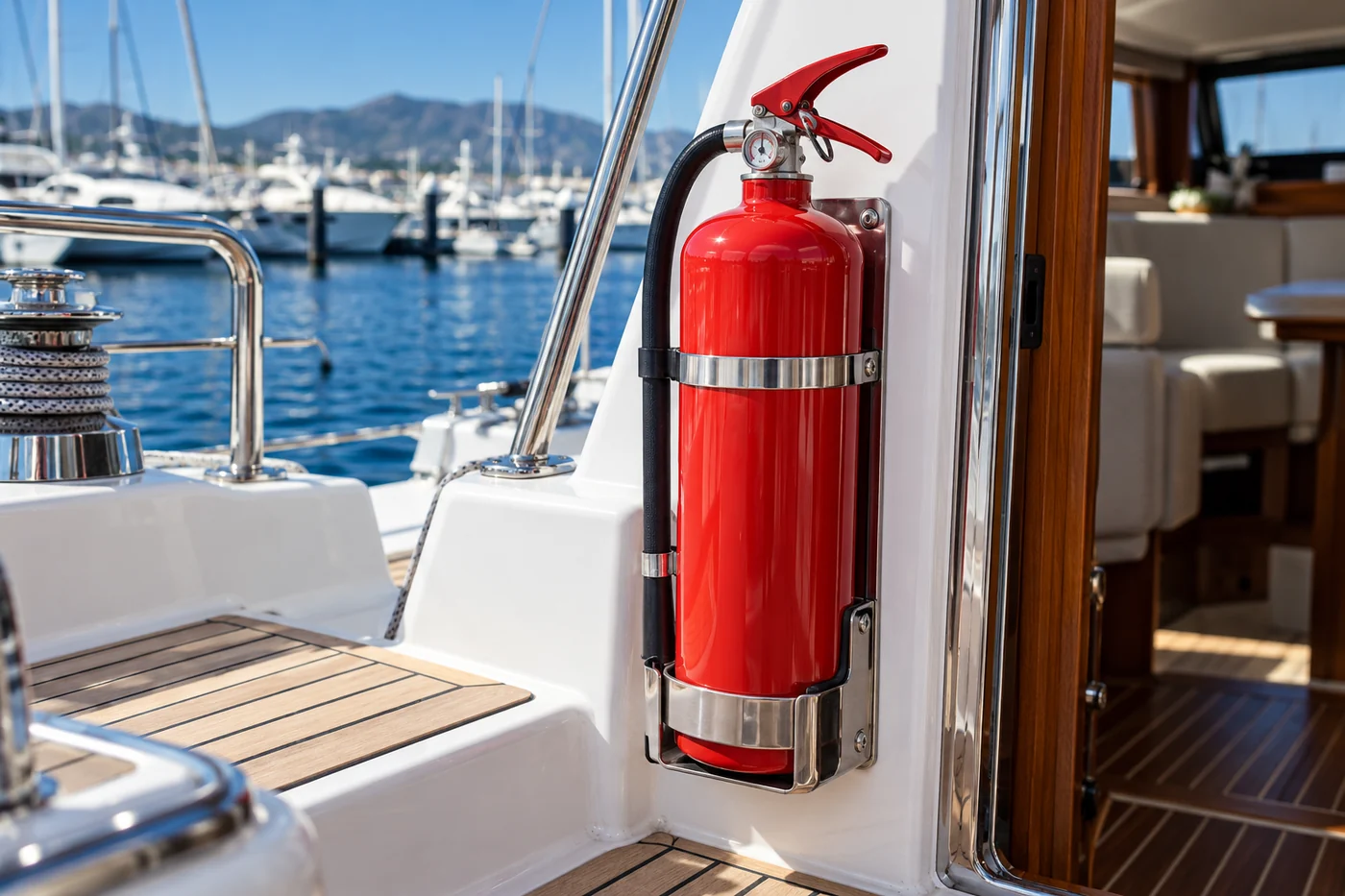
A fire extinguisher fitted on board.
Exemptions, tenders and extinguishers
Practical support
Understanding the requirements and recommendations around boat safety equipment Italy is an essential step in both the purchase and the sale of a vessel in this region. Whether considering a new acquisition or preparing a yacht for the market, compliance with local and international safety standards is fundamental to a smooth transaction.
Peter Mattey, a yacht broker at European Yacht Brokers, holds a BA in Law and has expertise in marine law, which helps when explaining how the rules affect a purchase or a sale. For Italian regulations and regional requirements, advice is provided by a locally qualified lawyer, so guidance is aligned with Italian law.
Anyone seeking to clarify the specific safety gear obligations for a particular type of vessel or operational distance from the Italian coast can submit an enquiry through the form on this page. Direct assistance is available for further detail or to discuss particular scenarios regarding ongoing or incoming transactions relating to boat safety equipment Italy.

Written by
Peter Mattey
Yacht Broker, European Yacht Brokers
BA (Law). Expert in marine law

The handover of a boat at the dock.
Your questions
Italian law sets minimum safety equipment according to distance from the coast. For unlimited range, a full liferaft, category-150 lifejackets for everyone, lights, a lifebuoy with line and light, two smoke signals, three hand flares, three parachute rockets, an EPIRB, VHF and GPS must be on board.
Within 6 nm, the requirements include category-100 lifejackets for all, a lifebuoy with line and light, two smoke signals, two hand flares, two parachute rockets, COLREG lights and a bilge pump or tool. On inland waters, category-100 lifejackets for everyone and a lifebuoy with line are mandatory as per Annex A.
A liferaft is required on boats in Italy, with the type depending on the distance from the coast. Within 12 nm, a coastal liferaft is needed, while a full liferaft is mandatory for voyages within 50 nm and unlimited navigation. Certain CE-marked inflatable boats are exempt if specific criteria are met.
Lifejackets are required in certain situations in Italy. A lifejacket must always be worn during solo night navigation. On inland waters, everyone on board must have a category-100 lifejacket, and a lifebuoy with a line is also mandatory. Within 1 nm, category-100 lifejackets must be provided for all on board.
A satellite phone may replace an EPIRB in Italy if it has a distress-message device to the IMRCC that conforms to D.Lgs. 128 of 22 June 2016 or DPR 239 of 20 December 2017 and meets EN 60945. The EPIRB itself must operate on 406 MHz and 121.5 MHz and comply with the same regulations.
Fire extinguisher requirements in Italy depend on whether a boat is CE-marked or not. For CE-marked units, the extinguishers are those fitted on board and listed in the owner’s manual. A non-CE natante needs one extinguisher: 13 B for up to 18.4 kW, 21 B above 18.4 up to 147 kW, and 34 B above 147 kW of installed power.
There is no requirement for periodic extinguisher inspection. The extinguisher must be in good condition, with the pressure indicator, if present, in the green zone. Class A or C extinguishers are permitted if they are also approved for class B.
Ready when you are
SANLORENZO SX88 Built by Sanlorenzo in 2018, LADY LARISA combines contemporary Italian design with versatile living spaces and a seamless connection to the water. Exterior
RIVA FOLGORE MAYAR represents an exceptional opportunity to acquire one of the newest yachts in her class, combining iconic Italian styling with impressive performance and
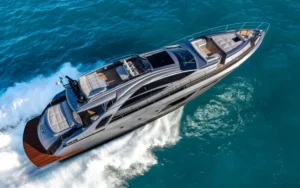
We are delighted to introduce an exceptional market opportunity: the outstanding Pershing 8X, offered at an asking price of €4,690,000 + VAT. This superb 2024
Check it yourself
The official gazette text of the safety-equipment table that the figures on this page come from.
The Italian Coast Guard’s answers to frequently asked questions about pleasure boats.
The Coast Guard’s page on entering a pleasure unit in the national register, the ATCN.
Keep reading

More guides for sellers and buyers: yacht brokers Italy.
More guides for sellers and buyers: yacht brokers Italy.

More guides for sellers and buyers: yacht brokers Italy.
Similar guides

More guides for sellers and buyers: yacht brokers Italy.
More guides for sellers and buyers: yacht brokers Italy.

More guides for sellers and buyers: yacht brokers Italy.
Talk to European Yacht Brokers
Looking for a boat? Tell us what you need
Tell us the type of boat, budget and area and a broker will reply.
More guides for sellers and buyers: yacht brokers Italy.
More guides for sellers and buyers: yacht brokers Italy.